For millions of Filipinos, commuting is not a daily routine but a daily ordeal. Metro Manila’s congestion alone drains an estimated ₱3.5 billion every day in lost productivity, wasted fuel, and delays — a figure projected to rise to ₱5.4 billion per day by 2035 if no systemic changes are made (Japan International Cooperation Agency, 2018). These numbers, staggering as they are, tell only part of the story. What they fail to capture are the countless human costs: the exhaustion of workers who spend three to four hours a day in traffic, the health risks borne by commuters trapped in floods or under punishing heat, and the stress of children running after jeepneys or buses in unsafe streets. The economic cost is vast, but the social and human toll is deeper still.
Air quality magnifies the problem. Transport-related emissions make Metro Manila’s air among the dirtiest in the region, with ambient air pollution causing around 66,000 premature deaths each year nationwide and economic damages estimated at ₱2.2 trillion annually (World Bank; WHO, 2023). Public utility vehicles, though a fraction of the fleet, account for the bulk of black soot emissions along roads, contributing disproportionately to heart and lung diseases. The invisible poison of polluted air silently erodes the nation’s health and productivity, while noise, stress, and sleep loss compound the daily wear and tear on human bodies.
Citizenship
Commuters have too often been asked to endure the unbearable as though it were destiny: standing for hours in overcrowded buses, wading through flooded intersections, or breathing exhaust fumes at roadside terminals. These struggles have been normalized as the “Filipino way of life.” But citizenship cannot mean resignation. It must mean demand — demand for mobility that is safe, dignified, and accessible to all.
For children, this means safe passage to school without risking life and limb on chaotic roads. For women, especially those who are pregnant, it means being able to reach clinics without exposure to heat stress, floods, or air pollution that endangers maternal health. For the elderly and persons with disabilities, it means having sidewalks, crossings, and public transport systems that do not exclude them from economic and social participation. These groups are not marginal; they are central to society. Every time a child misses class due to unsafe transport, every time an elderly person is confined to their home, or every time a person with disability is denied mobility, society pays a cost. These costs may not appear in budget spreadsheets, but they are real: in wasted human potential, lost productivity, and higher health expenditures.
Citizenship in this context means not just coping but raising voices, organizing for safer streets, defending civic spaces for advocacy, and demanding accountability in how transport budgets are spent. Mobility, like health or education, is a right — and it must be claimed as such.
Governance
The roots of the crisis lie in governance choices that have long favored cars over people. In Metro Manila, cars account for less than 30 percent of daily trips yet consume more than 70 percent of road space (MMDA, 2019). Public funds are channeled into road widening and flyovers that benefit a minority of private car users, while public transport systems, pedestrian spaces, and bicycle lanes remain fragmented, unsafe, and underfunded. Year after year, pork-barrel politics and budget insertions inflate road-building allocations, while the modernization of jeepneys, the improvement of bus systems, and the creation of safe, green pedestrian and cycling networks are delayed or neglected.
These priorities are distorted not by necessity but by politics. Projects vital for the majority — such as safe, affordable public transport, dignified pedestrian access, or green open spaces — are either denied adequate budgets or sidelined in favor of more “profitable” undertakings, profitable not for citizens but for those who see them as easier channels for corruption. The consequences are passed on to commuters and drivers, who are forced to shoulder modernization costs on top of the taxes they already pay. Jeepney and PUV modernization, for example, is framed as a step toward cleaner and safer transport, but structured in ways that make drivers bear the brunt of expenses. Requirements to obtain new franchises or to join cooperatives in order to “access loans” or government support transform modernization into a political weapon. Instead of being instruments of inclusive progress, these projects become levers of patronage, partisan control, and financial burden — while the larger public continues to suffer through unsafe, unreliable, and polluting systems.
Reversing this pattern requires deliberate governance choices. Legislation and regulation must prioritize investments in reliable public transport, safe cycling networks, and walkable urban design. Emission standards must be enforced to protect public health. Flood management must be integrated into transport planning, recognizing that every monsoon paralyzes mobility. Above all, transparency in procurement and spending is essential so that billions intended for transport modernization are not siphoned away. Governance that is people-first recognizes mobility not as a privilege but as a public right.
Private Sector
The private sector is both part of the problem and part of the solution. The car industry, construction firms, and mall-based developments have shaped cities to favor automobiles and car-owning elites, locking in a cycle of congestion and pollution. Contractors, too, have profited from bloated road projects, often in collusion with politicians, while everyday commuters shoulder the cost in wasted time and declining health.
Yet the private sector also has the capacity to innovate. Employers can ease the burden on workers by supporting hybrid work and flexible hours, reducing the necessity of commuting every day through floods and heat waves. Property developers can design mixed-use spaces that minimize travel distances and integrate flood-resilient, walkable environments. Logistics and transport companies can invest in electric vehicles and cleaner fleets, reducing emissions and operating costs at the same time. By aligning their practices with sustainability, businesses can transform mobility into both a public good and a market opportunity.
The challenge is to move away from dependency on car sales and car-centric development toward innovation that supports people-centered, climate-resilient mobility. Just as collusion drains resources, innovation multiplies them.
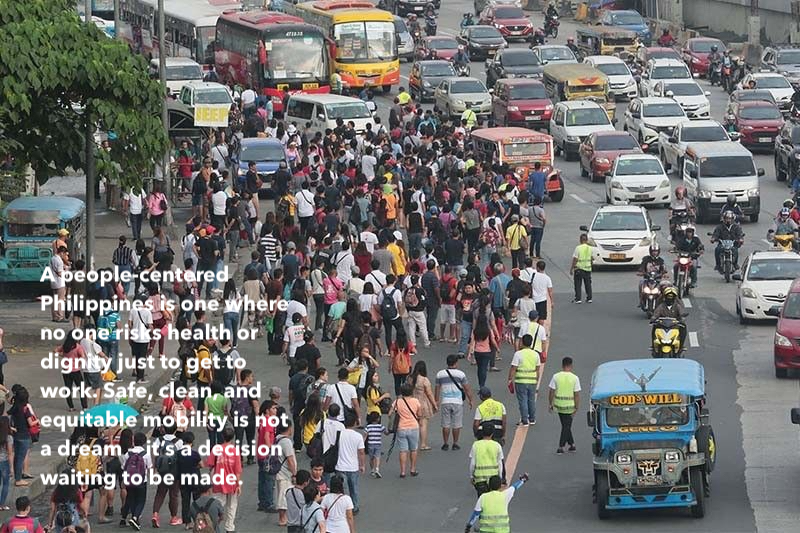
From Car-Centric Chaos to Hybrid Futures
Around the world, cities have shown what is possible. Bogotá’s bus rapid transit has given commuters affordable, reliable mobility. Paris and Copenhagen have reallocated road space to bicycles and pedestrians, reducing both emissions and stress. Jakarta has experimented with car-free days, reclaiming streets for people. Even in the Philippines, the EDSA busway has shown that dedicated lanes can make commuting safer and faster when governance is firm.
But the future of mobility is not only about cleaner buses, wider sidewalks, or protected bike lanes. It is also about rethinking why, when, and how often people must travel. The pandemic proved that not every job or class requires daily presence. Hybrid work and study models — supported by community hubs with reliable internet, safe workstations, and childcare facilities — reduce demand on clogged roads and overcrowded vehicles. These arrangements are not luxuries; they are lifelines in a country where floods, extreme heat, and pollution make commuting hazardous. By cutting unnecessary trips, hybrid systems ease congestion, lower emissions, and protect health, while freeing up resources for those who must travel — nurses, drivers, factory workers, food vendors.
Linking transport reform with hybrid futures offers the clearest path out of car-centric chaos. It allows the Philippines to reclaim time, health, and dignity from the grip of traffic and smog.
Toward People-Centered Mobility
The chaos of Philippine transport is not inevitable. It is the outcome of choices that prioritized cars over people, profit over public good, and collusion over accountability. Yet just as choices created this crisis, different choices can end it. Citizens must refuse resignation and demand safer, more inclusive mobility. Governance must redirect resources from car-first infrastructure to people-first systems that serve the majority. The private sector must shift from dependency to innovation, aligning its growth with sustainable and equitable mobility.
The costs of congestion — the billions lost daily, the 66,000 premature deaths each year, the rising toll of road crashes — are already staggering. But layered onto these are the uncounted losses borne by children, pregnant women, the elderly, and persons with disabilities who are denied safe and dignified passage. These are not just deficits in equity and justice but real economic losses in health care costs, wasted productivity, and wasted human potential. Accounting for them makes the case for change even stronger.
Mobility and clean air are not luxuries. They are foundations of survival, health, and dignity. A Philippines that embraces people-centered mobility — tied to adaptable, hybrid work and study systems — can move beyond traffic and smog toward a future where everyone, regardless of age, gender, or ability, has the right to safe, healthy, and dignified movement.


