The COVID-19 pandemic revealed both the fragility and the resilience of education systems. Schools closed their doors for months, leaving millions of students in the Philippines to navigate online classes with patchy internet, limited devices, and cramped living spaces. The learning losses were profound. The World Bank estimates that as many as nine out of ten Filipino children aged 10 struggle to read and understand simple text — a crisis worsened by prolonged school closures and unequal access to technology.
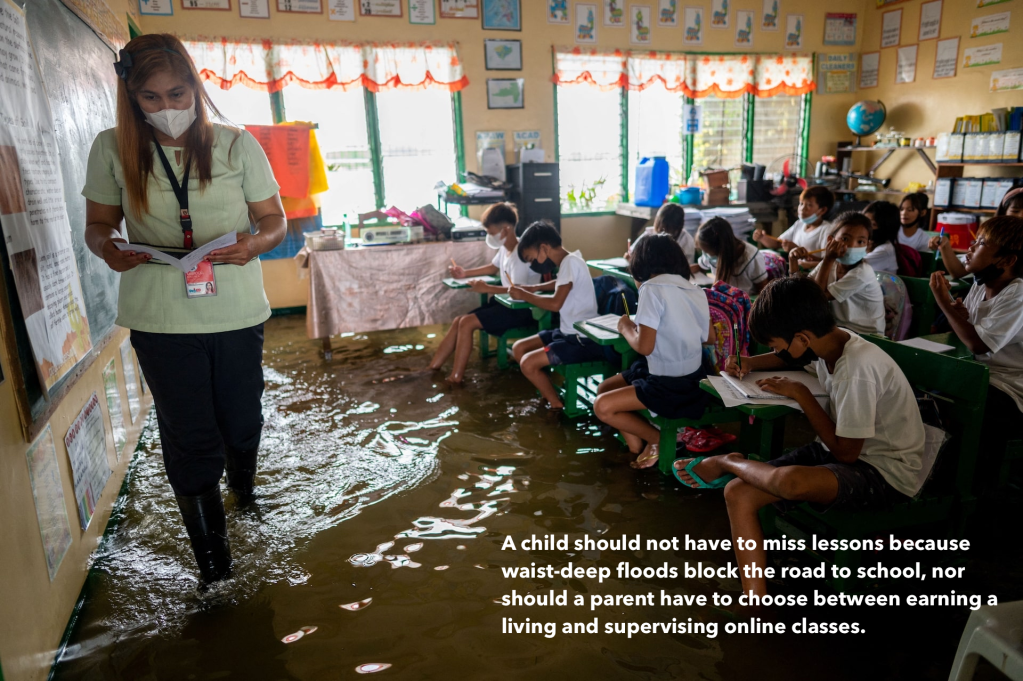
Disruptions have continued beyond the pandemic, intensified by climate extremes. In the 2023–2024 school year alone, students lost about 32 teaching days due to extreme weather and heat (PIDS, 2024). Storm Trami in October 2024 disrupted learning for more than 19 million students across the country (Save the Children / DepEd). Between 2021 and 2023, disasters damaged nearly 4,000 schools, interrupting education for about 2 million children (World Bank / DepEd). These are not isolated interruptions; they accumulate, widening learning gaps that are hardest to close for children in poverty, rural communities, and hazard-prone areas.
Citizenship: Active Co-Creators
For too long, education has been treated as a service delivered from the top down. But citizens — parents, students, teachers, and community groups — can reshape the way learning is organized. Community hubs at the barangay level could provide shared access to fast internet, computer stations, common study areas, and even creches or day care centers for young children. By reducing the reliance on long, unsafe commutes and uneven home environments, such hubs would level the playing field for children who currently study in noisy cafés or cramped homes without internet.
Citizenship here means asserting that learning is a right, not a privilege. It means demanding that public budgets prioritize education infrastructure in the same way that they prioritize roads and bridges. It means defending civic spaces where parents, learners, and local leaders can co-create solutions — ensuring that no child is left behind because of geography, poverty, or disaster.
Governance and Education
Public spending on education in the Philippines remains far below international benchmarks, with allocations still under UNESCO’s recommended 6 percent of GDP. This underinvestment is visible in classrooms that double as evacuation centers, in school buildings unfit for floods or heat waves, and in the lack of reliable digital infrastructure.
Legislation and budgets must treat broadband access, safe learning spaces, and resilient schools as essential public goods. Every barangay should have at least one fully equipped education and community hub, with reliable connectivity, computers, safe lighting, and secure spaces for study. New school buildings should be designed with disaster resilience in mind — raised floors for floods, proper ventilation for extreme heat, and backup power sources for emergencies. Governance that invests in education is governance that invests in resilience.
Meaningful and Profitable Partnerships
The private sector has long profited from education through tuition, gadgets, and connectivity charges. Yet education cannot be treated as a commodity alone. Telecommunications companies, in particular, play a decisive role. Their services keep schools and hubs connected, but service interruptions or poor investment leave communities vulnerable. Worse, dependence on foreign-made infrastructure exposes digital systems to risks of espionage, sabotage, or cyber-attacks — vulnerabilities that can undermine not just education but national security.
Here, partnership is key. Telecom providers can commit to universal, affordable internet packages for schools and hubs. Tech companies can contribute recycled or low-cost devices and software, while also investing in cybersecurity training for students and teachers. Developers can design residential and commercial projects that integrate shared study spaces, ensuring that connectivity is built into the fabric of communities. By moving from extraction to partnership, the private sector strengthens both its market and its social contract.
From Disruption to Opportunity
The future of education is not about abandoning schools but about broadening where and how learning happens. Hybrid models, where physical classrooms are complemented by digital tools and community hubs, reduce the vulnerability of education systems to floods, heat waves, and future pandemics. A child should not have to miss lessons because waist-deep floods block the road to school, nor should a parent have to choose between earning a living and supervising online classes.
Community hubs can bridge these gaps. They provide safe and equitable access to learning, reduce unnecessary commutes, and create resilience against disasters. They also help protect education from digital risks by decentralizing access and embedding safeguards. In this sense, education becomes not only a pathway to personal opportunity but also a community-wide investment in resilience.
Toward an Equitable Learning Future
The crisis of education is inseparable from the crises of climate, mobility, and governance. But it is also inseparable from hope. The lessons of the pandemic — that adaptability, technology, and community matter — can be turned into blueprints for long-term reform. Citizens must demand hubs and hybrid systems as rights, not privileges. Governance must sustain investments in both schools and digital infrastructure. And the private sector must treat connectivity and safety as responsibilities, not mere revenue streams.
The Philippines cannot afford to lose another generation to outdated systems, recurring disasters, or digital vulnerabilities. Education and community hubs, grounded in equity and resilience, offer a path forward: a future where learning is universal, adaptive, secure, and just — no matter the storm, the flood, or the heat.


