From Car-Centric Chaos to People-Centered Solutions

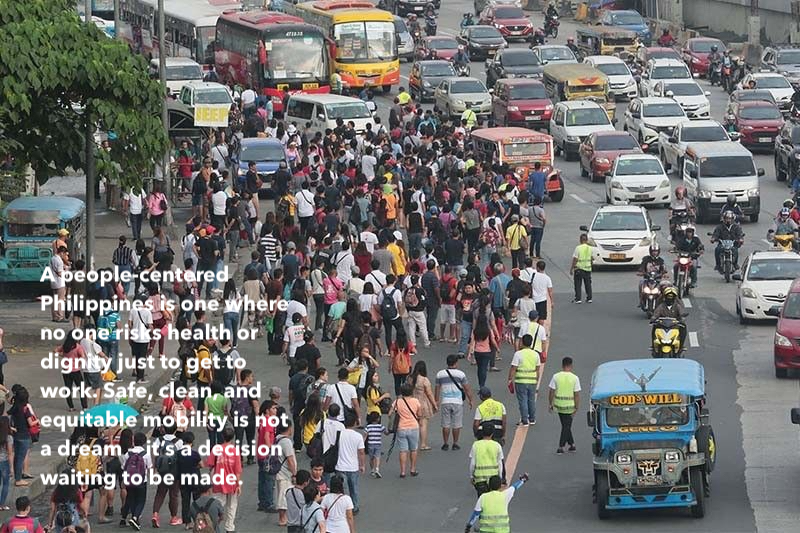
For millions of Filipinos, commuting is not a daily routine but a daily ordeal. Metro Manila’s congestion alone drains an estimated ₱3.5 billion every day in lost productivity, wasted fuel, and delays — a figure projected to rise to ₱5.4 billion per day by 2035 if no systemic changes are made (Japan International Cooperation Agency, 2018). These numbers, staggering as they are, tell only part of the story. What they fail to capture are the countless human costs: the exhaustion of workers who spend three to four hours a day in traffic, the health risks borne by commuters trapped in floods or under punishing heat, and the stress of children running after jeepneys or buses in unsafe streets. The economic cost is vast, but the social and human toll is deeper still.

Air quality magnifies the problem. Transport-related emissions make Metro Manila’s air among the dirtiest in the region, with ambient air pollution causing around 66,000 premature deaths each year nationwide and economic damages estimated at ₱2.2 trillion annually (World Bank; WHO, 2023). Public utility vehicles, though a fraction of the fleet, account for the bulk of black soot emissions along roads, contributing disproportionately to heart and lung diseases. The invisible poison of polluted air silently erodes the nation’s health and productivity, while noise, stress, and sleep loss compound the daily wear and tear on human bodies.

Citizenship

Commuters have too often been asked to endure the unbearable as though it were destiny: standing for hours in overcrowded buses, wading through flooded intersections, or breathing exhaust fumes at roadside terminals. These struggles have been normalized as the “Filipino way of life.” But citizenship cannot mean resignation. It must mean demand — demand for mobility that is safe, dignified, and accessible to all.

For children, this means safe passage to school without risking life and limb on chaotic roads. For women, especially those who are pregnant, it means being able to reach clinics without exposure to heat stress, floods, or air pollution that endangers maternal health. For the elderly and persons with disabilities, it means having sidewalks, crossings, and public transport systems that do not exclude them from economic and social participation. These groups are not marginal; they are central to society. Every time a child misses class due to unsafe transport, every time an elderly person is confined to their home, or every time a person with disability is denied mobility, society pays a cost. These costs may not appear in budget spreadsheets, but they are real: in wasted human potential, lost productivity, and higher health expenditures.

Citizenship in this context means not just coping but raising voices, organizing for safer streets, defending civic spaces for advocacy, and demanding accountability in how transport budgets are spent. Mobility, like health or education, is a right — and it must be claimed as such.

Governance

The roots of the crisis lie in governance choices that have long favored cars over people. In Metro Manila, cars account for less than 30 percent of daily trips yet consume more than 70 percent of road space (MMDA, 2019). Public funds are channeled into road widening and flyovers that benefit a minority of private car users, while public transport systems, pedestrian spaces, and bicycle lanes remain fragmented, unsafe, and underfunded. Year after year, pork-barrel politics and budget insertions inflate road-building allocations, while the modernization of jeepneys, the improvement of bus systems, and the creation of safe, green pedestrian and cycling networks are delayed or neglected.

These priorities are distorted not by necessity but by politics. Projects vital for the majority — such as safe, affordable public transport, dignified pedestrian access, or green open spaces — are either denied adequate budgets or sidelined in favor of more “profitable” undertakings, profitable not for citizens but for those who see them as easier channels for corruption. The consequences are passed on to commuters and drivers, who are forced to shoulder modernization costs on top of the taxes they already pay. Jeepney and PUV modernization, for example, is framed as a step toward cleaner and safer transport, but structured in ways that make drivers bear the brunt of expenses. Requirements to obtain new franchises or to join cooperatives in order to “access loans” or government support transform modernization into a political weapon. Instead of being instruments of inclusive progress, these projects become levers of patronage, partisan control, and financial burden — while the larger public continues to suffer through unsafe, unreliable, and polluting systems.

Reversing this pattern requires deliberate governance choices. Legislation and regulation must prioritize investments in reliable public transport, safe cycling networks, and walkable urban design. Emission standards must be enforced to protect public health. Flood management must be integrated into transport planning, recognizing that every monsoon paralyzes mobility. Above all, transparency in procurement and spending is essential so that billions intended for transport modernization are not siphoned away. Governance that is people-first recognizes mobility not as a privilege but as a public right.

Private Sector

The private sector is both part of the problem and part of the solution. The car industry, construction firms, and mall-based developments have shaped cities to favor automobiles and car-owning elites, locking in a cycle of congestion and pollution. Contractors, too, have profited from bloated road projects, often in collusion with politicians, while everyday commuters shoulder the cost in wasted time and declining health.

Yet the private sector also has the capacity to innovate. Employers can ease the burden on workers by supporting hybrid work and flexible hours, reducing the necessity of commuting every day through floods and heat waves. Property developers can design mixed-use spaces that minimize travel distances and integrate flood-resilient, walkable environments. Logistics and transport companies can invest in electric vehicles and cleaner fleets, reducing emissions and operating costs at the same time. By aligning their practices with sustainability, businesses can transform mobility into both a public good and a market opportunity.

The challenge is to move away from dependency on car sales and car-centric development toward innovation that supports people-centered, climate-resilient mobility. Just as collusion drains resources, innovation multiplies them.
From Car-Centric Chaos to Hybrid Futures

Around the world, cities have shown what is possible. Bogotá’s bus rapid transit has given commuters affordable, reliable mobility. Paris and Copenhagen have reallocated road space to bicycles and pedestrians, reducing both emissions and stress. Jakarta has experimented with car-free days, reclaiming streets for people. Even in the Philippines, the EDSA busway has shown that dedicated lanes can make commuting safer and faster when governance is firm.

But the future of mobility is not only about cleaner buses, wider sidewalks, or protected bike lanes. It is also about rethinking why, when, and how often people must travel. The pandemic proved that not every job or class requires daily presence. Hybrid work and study models — supported by community hubs with reliable internet, safe workstations, and childcare facilities — reduce demand on clogged roads and overcrowded vehicles. These arrangements are not luxuries; they are lifelines in a country where floods, extreme heat, and pollution make commuting hazardous. By cutting unnecessary trips, hybrid systems ease congestion, lower emissions, and protect health, while freeing up resources for those who must travel — nurses, drivers, factory workers, food vendors.

Linking transport reform with hybrid futures offers the clearest path out of car-centric chaos. It allows the Philippines to reclaim time, health, and dignity from the grip of traffic and smog.

Toward People-Centered Mobility

The chaos of Philippine transport is not inevitable. It is the outcome of choices that prioritized cars over people, profit over public good, and collusion over accountability. Yet just as choices created this crisis, different choices can end it. Citizens must refuse resignation and demand safer, more inclusive mobility. Governance must redirect resources from car-first infrastructure to people-first systems that serve the majority. The private sector must shift from dependency to innovation, aligning its growth with sustainable and equitable mobility.

The costs of congestion — the billions lost daily, the 66,000 premature deaths each year, the rising toll of road crashes — are already staggering. But layered onto these are the uncounted losses borne by children, pregnant women, the elderly, and persons with disabilities who are denied safe and dignified passage. These are not just deficits in equity and justice but real economic losses in health care costs, wasted productivity, and wasted human potential. Accounting for them makes the case for change even stronger.

Mobility and clean air are not luxuries. They are foundations of survival, health, and dignity. A Philippines that embraces people-centered mobility — tied to adaptable, hybrid work and study systems — can move beyond traffic and smog toward a future where everyone, regardless of age, gender, or ability, has the right to safe, healthy, and dignified movement.
Health and Climate Resilience

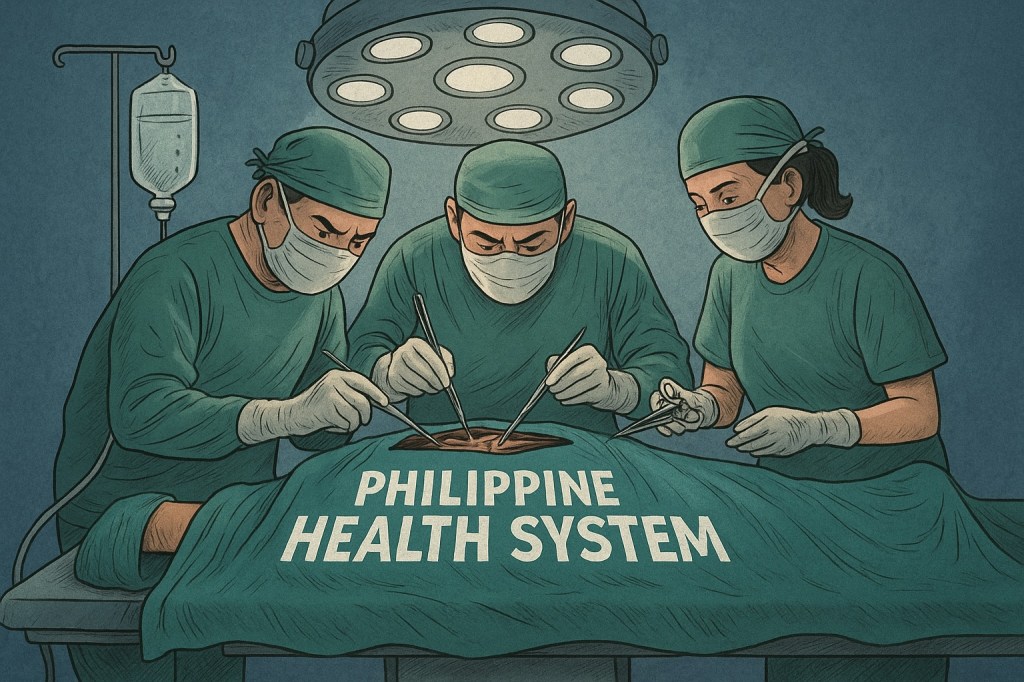
The COVID-19 pandemic was not only a public health emergency; it was a stress test that revealed the limits of the Philippine health system and the fragility of everyday survival for millions of families. Despite one of the longest lockdowns in the world, the country suffered more than 66,000 excess deaths in 2021 (Philippine Statistics Authority, 2022). Hospitals overflowed, health workers were pushed to their limits, and corruption in medical procurement further eroded trust in institutions that should have been the backbone of protection. Lockdowns were meant to contain the virus, but because so many Filipinos lived without savings or safety nets, people had little choice but to venture out in search of work. In the process, the virus spread more widely, and the economic and social costs mounted.

Yet the pandemic also offered lessons that matter for the future. Hygiene practices became widespread almost overnight. Community health workers proved indispensable in delivering basic services, often with little recognition. Families discovered the importance of nutrition, exercise, and shared responsibility for well-being. These shifts, however uneven, underscore that health resilience begins not in hospitals alone but in the cultural fabric of daily life. And this is where the story moves from pandemic to climate. The current normal of unseasonal storms, prolonged floods, and extreme heat waves is already compounding health risks. In 2023, the Department of Health recorded 513 cases of heat-related illness, while the first quarter of 2024 saw six heat-related deaths (DOH/CCC, 2024). Heat indices above 42 °C are now common in urban areas, placing students, commuters, and outdoor workers in danger (ABS-CBN, 2025). Floods continue to spread waterborne diseases such as leptospirosis and diarrhea, while mosquito-borne illnesses like dengue thrive in warmer, wetter conditions. Health and climate are no longer separate issues; they are part of a single, urgent struggle for resilience.

Citizenship: Shared Responsibility

The pandemic reminded Filipinos that health is not an individual pursuit but a shared responsibility. Communities quickly adapted to new hygiene habits, proving that cultural norms can shift when survival is at stake. Yet sustaining these practices requires more than fear of disease; it calls for citizens who see their own health as inseparable from that of their neighbors. Community clean-ups, sanitation campaigns, and vigilance against dengue are all forms of shared action that strengthen resilience at the most local level. Barangay health workers remain the unsung heroes of this effort — underpaid, under-equipped, but essential in linking households to the broader health system. Civil society organizations also play a critical role, defending public health budgets and demanding equitable access to care. When citizens organize, they transform coping into collective power, and resilience becomes not just survival but dignity.

Governance: Preventive Systems

The chronic underinvestment in Philippine health care has long been evident. At roughly 5 percent of GDP, health spending falls short of the 7 percent recommended by the World Health Organization for countries at the Philippines’ level of development. This leaves hospitals overcrowded, rural clinics understaffed, and laboratories under-equipped. During the pandemic, these weaknesses turned deadly, as reactive, crisis-driven measures failed to prevent thousands of avoidable deaths. Building resilience requires a different approach: one that invests in foresight rather than scrambling in response. Barangay health stations and municipal clinics must be expanded, laboratories equipped for early detection, and surveillance systems strengthened to monitor climate-sensitive pathogens — from dengue-carrying mosquitoes to waterborne bacteria and zoonotic spillovers from displaced animal habitats. The Universal Health Care Act of 2019 remains a promising framework, but it demands consistent funding and transparent implementation. Health must also be fully integrated into disaster risk reduction, so that every evacuation plan for floods or heatwaves includes sanitation, medical care, and continuity of services. Governance, in short, must move from reactive firefighting to preventive protection.

Private Sector: Profits, Common Good, and Market Growth

The private sector has often seen health as a narrow concern — workplace safety, employee wellness programs, and insurance coverage. Yet the pandemic blurred the line between workplace and community health, and climate change is erasing that line altogether. Companies cannot thrive in communities plagued by heat stress, dengue outbreaks, or constant flooding. Businesses have both a duty and an interest in treating public health as part of their mandate. Employers can provide cooling spaces and flexible work arrangements that protect workers during extreme heat. Developers can invest in urban greening — shaded walkways, green roofs, and pocket parks — that reduce urban heat islands while also enhancing livability. Agribusiness and food companies can strengthen surveillance of livestock and wildlife supply chains to reduce the risk of zoonotic diseases. And perhaps most crucially, corporations must abandon collusion in corruption that drains public resources, and instead align their investments with public health goals. When companies shift from seeing health as a cost to seeing it as a source of resilience, they contribute to the common good — and in the process, they strengthen the very markets on which they depend. From profits, to common good, to market growth: this must become the cycle of a sustainable economy.

From Pandemic Lessons to Climate Futures

There are models worth emulating. Cuba, despite its limited wealth, has built one of the world’s most resilient health systems by focusing on prevention and community care. Thailand, through its Universal Health Coverage reforms, demonstrated that even middle-income countries can achieve broad, equitable access to health. Medellín in Colombia reduced urban heat and improved public health simultaneously by creating “green corridors” — an integrated approach that Philippine cities could readily adapt. And closer to home, Marikina has shown how disaster response can be health-centered, Iloilo has rehabilitated its riverbanks to reduce disease risks and improve urban space, and barangay health workers across the country have demonstrated resilience against all odds.

The pandemic revealed the costs of a health system that is underfunded, reactive, and corrupt. Climate change is now amplifying those risks, ensuring that floods, storms, and heatwaves will increasingly shape the health of the nation. Building resilience is not optional; it is survival. It begins with citizens who treat health as a shared responsibility, continues with governance that invests in prevention rather than reaction, and extends to a private sector that recognizes public health as both duty and opportunity. The lesson of the pandemic is clear: resilience is not simply bouncing back. It is transforming the very systems that failed — so that they do not fail again in the face of the next crisis.

Building Resilience Beyond Sandbags and Scandals

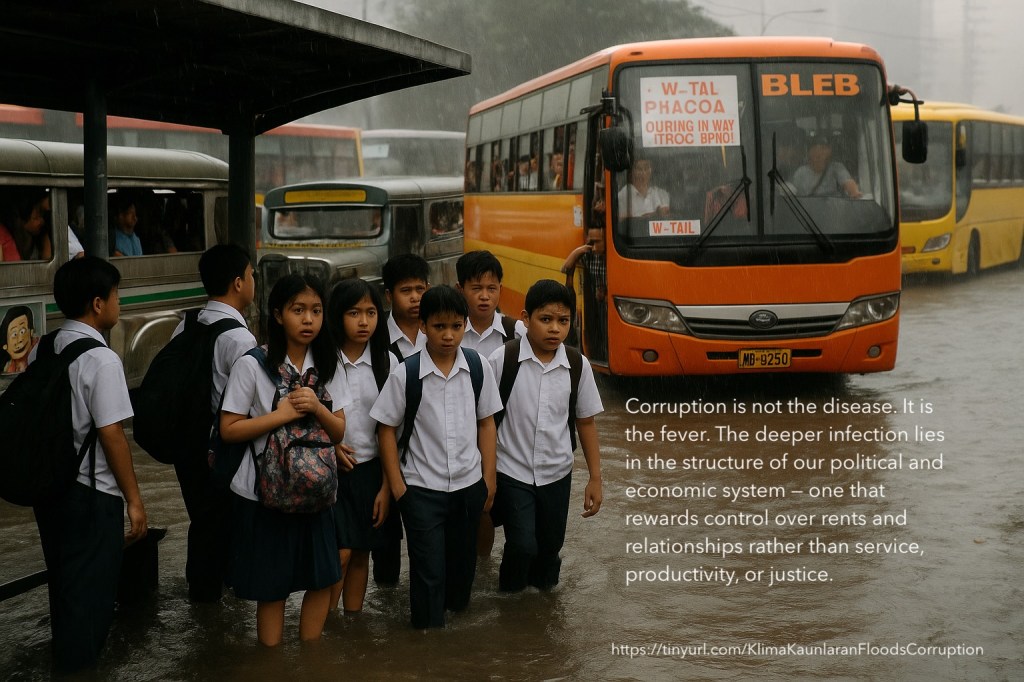
Every rainy season, Filipinos brace themselves for the same ordeal: flooded streets, stranded commuters, classrooms turned into evacuation centers, and homes filled knee-deep with murky water. According to the World Bank, more than 14 million Filipinos are exposed to flooding each year, with damages averaging ₱133 billion (≈US$2.4 billion) annually in lost assets, livelihoods, and productivity (World Bank, 2022).

Climate change is already magnifying this threat. PAGASA projects that extreme daily rainfall events will become more frequent, particularly in Luzon and the Visayas. At the same time, sea levels around the Philippines are rising at nearly double the global average — between 5.7 and 7.0 millimeters per year — making coastal flooding more frequent and destructive (World Meteorological Organization, 2023; PAGASA). Combined with rapid urbanization, clogged drainage systems, and the spread of informal settlements into floodplains, the current normal of yearly floods will only worsen unless the country embraces systemic change.

Citizenship and Culture: Demanding Change

For decades, citizens have been expected to “cope” with floods by stacking sandbags, raising furniture, or wading through waist-deep water. These coping mechanisms, repeated year after year, normalize disaster and shift responsibility to households that are often the least equipped to manage it. Resilience, however, must go beyond individual sacrifice.

True citizenship in the face of flooding means demanding transparency in how flood control budgets are spent. Billions of pesos are inserted into the General Appropriations Act every year for flood control projects, yet many are poorly built or never completed at all, as the Commission on Audit has repeatedly flagged. Civic groups, barangay councils, and homeowners’ associations can serve as watchdogs, pushing back against the entrenched culture of “budget insertions” that fuels corruption. At the same time, culture itself matters: reducing household waste that clogs drainage, participating in greening efforts, and embracing resilience as a shared responsibility all help ensure that solutions are not purely technical, but also social and cultural.

Floods are not inevitable acts of fate. They are failures of planning, governance, and accountability. Citizens have both the power and responsibility to demand more.

Governance: Protection

The governance failures in flood management are glaring. Between 2022 and 2024 alone, the government allocated ₱545 billion for flood control projects, yet many of these projects were later flagged as substandard, overpriced, or even non-existent (Reuters, 2025). Each year, the National Expenditure Program is transformed into the General Appropriations Act through budgetary “insertions” that inflate flood control allocations well beyond technical needs. Instead of protecting citizens, these projects too often become conduits for political patronage and private gain.

Shifting from pork to protection requires a new governance framework. Legislation must establish climate-resilient infrastructure standards, mandating underground floodwater reservoirs, expanded drainage networks, permeable pavements, and the integration of green infrastructure in all new developments. Urban planning must adopt a landscape approach that respects natural waterways, wetlands, and river basins, rather than building over them. Independent oversight bodies such as the Commission on Audit and the Ombudsman must be empowered to prosecute ghost projects and penalize both officials and contractors engaged in corruption. Finally, relocation and housing strategies must prioritize the poor, ensuring that informal settlers are not simply evicted from flood-prone areas but offered dignified, safe alternatives.

Without accountability and foresight, even the most sophisticated engineering projects will fail. Flood control must no longer be treated as a political prize but as a public necessity.

Private Sector: Innovation

The private sector occupies a complicated space in the story of floods. On the one hand, construction firms and contractors have too often been complicit in overpricing, license-renting, and ghost projects, benefiting from the very corruption that undermines public resilience. On the other, businesses also possess the expertise, technology, and resources that could drive innovative solutions.

For the private sector to shift from collusion to innovation, it must refuse participation in corrupt bidding schemes and commit to integrity in procurement. Developers can incorporate flood-resilient designs, including underground cisterns, elevated foundations, and permeable surfaces that reduce runoff. Partnerships with government could expand drainage systems, establish rainwater harvesting schemes, and invest in wastewater reuse, turning floodwater from a hazard into a resource. More fundamentally, businesses must see resilience not as a burden but as a market opportunity. Companies that lead in climate-resilient infrastructure will not only protect communities but also open new domestic and international markets. The cycle must change: from profits alone, to public good, and back again to market growth.

Learning from Models Abroad

The Philippines does not need to invent solutions from scratch. Other countries have faced similar threats and built models worth adapting. In Tokyo, the Metropolitan Area Outer Underground Discharge Channel is a vast system of tunnels and tanks that capture excess floodwater during storms. While prohibitively expensive at full scale, smaller underground cisterns beneath parks or intersections could be piloted in Manila or Cebu. In Singapore, the Marina Barrage functions as both a tidal barrier and a freshwater reservoir, while also serving as public space — a model of how infrastructure can combine resilience with livability. The Netherlands’ “Room for the River” program restores floodplains and wetlands, proving that giving rivers more space can sometimes be more effective than raising dikes. Bangkok’s “Monkey Cheek” reservoirs, where urban parks double as floodwater retention basins, offer a low-cost solution particularly relevant for dense Asian cities.

Philippine Pilots: Proof It’s Possible

Encouragingly, there are also homegrown examples that show resilience is possible when governance and citizen action align. Marikina City has developed a community-based flood warning system that provides real-time alerts, saving lives during typhoons. Iloilo has rehabilitated its river through mangrove replanting, clean-ups, and strict zoning enforcement, transforming a once-polluted waterway into a model of flood mitigation and urban renewal. Cebu has piloted rainwater harvesting systems in schools and barangays, demonstrating how small-scale innovations can reduce both flooding and water scarcity. Naga City has integrated participatory governance into its disaster planning, ensuring that citizens themselves are partners in shaping resilience strategies.

These local cases prove that innovation and accountability can make a tangible difference. The challenge lies in scaling them up and protecting them from the corruption that undermines so many other efforts.

Toward Flood-Proof Cities

Floods will never disappear entirely in a tropical archipelago like the Philippines. But the devastation we experience today is not inevitable. It is the result of political choices — to treat flood control as pork, to build on natural waterways, to neglect drainage, and to collude rather than innovate.

The path forward is equally a matter of choice. Citizens must refuse to normalize disaster and instead demand transparency. Governance must redirect flood control spending from patronage to protection. The private sector must move beyond collusion and embrace innovation as both duty and opportunity. And the Philippines must draw lessons not only from Tokyo, Singapore, the Netherlands, and Bangkok, but also from its own successes in Marikina, Iloilo, Cebu, and Naga.

Adapted, scaled, and protected from corruption, these models can move the country beyond sandbags and scandals — toward cities that protect lives, livelihoods, and dignity in the face of a changing climate.

Imagining a Post-COVID World – looking and moving forward

The COVID-19 pandemic brought the world to a standstill. Streets fell silent, workplaces closed their doors, schools went online, and families were confined to their homes. For many in the Philippines, these disruptions were particularly harsh. Lockdowns were extended for months, yet instead of controlling infections, they revealed the cracks in governance, the fragility of our systems, and the limits of resilience for millions of ordinary citizens. People needed to work to survive, but most had neither savings nor recourse to safety nets. Daily wage earners were forced to go out in search of income, fueling the continued spread of the virus. Despite enduring one of the world’s longest lockdowns, the country suffered large-scale losses in human life, while corruption in government procurement — from overpriced medical supplies to questionable contracts — undermined public trust when it was needed most.

Yet the pandemic was not only a story of loss. It also forced societies to reimagine how life, work, and community could function differently. The sudden shift to remote work showed that many jobs can be done from home without sacrificing productivity. People discovered they could save fuel, reduce commuting time, and spend more hours with family. For cities notorious for traffic congestion and pollution, hybrid work arrangements offered a glimpse of a future with fewer cars on the road and cleaner air. What was once a privilege of the few should now be recognized as a necessity, an innovation, and even a right — not only to protect health in times of crisis but to reduce the stress, costs, and hazards of unsustainable daily commuting.

Remote learning carried similar lessons. Though uneven and difficult for many, it demonstrated that parents could be more involved in their children’s education and that schools could reimagine how to balance classroom instruction with digital tools. In communities where flooding, heat, or transport makes attending school a daily ordeal, flexible learning arrangements could relieve both financial and health burdens. At the same time, the pandemic underscored that learning from home can only succeed if it is supported by reliable and accessible internet connectivity, safe community hubs, and policies that bridge the gap between rich and poor.

The crisis also reshaped attitudes toward health and hygiene. Handwashing, sanitation, and fitness became more widely recognized as essential to resilience. People began to think more carefully about diet, exercise, mental well-being, and the fragility of their own health. But the pandemic also revealed a cruel divide: those with space at home could exercise, work remotely, shelter safely, and even tend to their home gardens, while millions in cramped housing or informal settlements could not. Resilience, in this sense, was as much about poverty and inequality as it was about public health.

These lessons extend beyond individual households to the broader systems that sustain life. Food production and essential services must continue during crises, but workers in these sectors were often the least resilient and protected. Forests and ecosystems, when preserved, act as natural buffers against zoonotic diseases; when destroyed, they release new risks into human communities. The pandemic reminded us that human health cannot be separated from the health of ecosystems. Preserving habitats and limiting the displacement of animals and viruses are not environmental luxuries — they are public health necessities.

Underlying all of this is the recognition that change cannot be left to individuals alone. A cultural shift in lifestyles and consumption is vital, but without legislation and accountable governance to support it, the system defaults back to old patterns. The pandemic era was rife with corruption, not only in health supplies but also in infrastructure spending, including flood control projects where billions were allocated but many outputs were substandard, overpriced, or simply non-existent. These scandals illustrate the depth of collusion among private contractors, politicians, andgovernment agencies, with citizens too often passive in demanding accountability. If nothing changes, the same patterns of waste and patronage will cripple the country’s ability to cope with future crises.

The private sector also bears responsibility. During the pandemic, some companies protected workers through flexible arrangements, safe facilities, and digital support. Others lobbied for quick reopening regardless of risks or used the crisis as an excuse for retrenchments. As the country reimagines its future, businesses must shift from a narrow focus on profit toward a recognition that their long-term growth depends on secure working conditions and the common good. This means investing in hybrid work infrastructure, ensuring safe working conditions during extreme heat and floods, and refusing collusion in corruption that drains public funds away from essential services. From profit to common good, and back again to market growth — this is the logic that must replace the destructive cycle of greed and short-term, unfair advantages.

The pandemic was a global tragedy, but it was also a rehearsal for the crises that climate change is now making permanent. Extreme heat, unseasonal floods, and stronger storms are the “current normal.” To cope, the Philippines must build systems that prioritise resilience, equity, and accountability. Citizens must adopt new cultural habits that value health, sustainability, and solidarity (e.g., damayan or bayanihan) – a sense of safe community. Governance must be strengthened through legislation that protects the public good and through institutions that resist corruption. The private sector must innovate not just for profit but for the survival and dignity of people.

Imagining a post-COVID world is not about going back to how things were. It is about taking the painful lessons of the pandemic and using them to reorganize how we live, work, learn, and play — with implications that reach across social, economic, political, and ecological systems. Only then can we hope to cope better with the crises ahead and begin the long work of rehabilitating the systems — including the climate — on which future generations depend.

Next: Flood-Proof Cities – Building Resilience Beyond Sandbags and Scandals

Disabusing our democracy

Social media has become the platform for bots and real netizens alike to abuse with utter impunity, ideas and concepts otherwise held sacred by our society.

One such idea is democracy, both attacked and used in the most irresponsible and nonsensical ways. One of them as an excuse for its own abuse, another for the most flippant misuse of other equally lofty ideals. Some of us, especially in social media, hold the notion that the practice of democracy is equal to the freedom of spreading lies and disinformation, the wanton abuse and horrific distortion of facts and history, without any consequence. That is the opposite, if not the destroyer, of democracy.

Freedom has now become synonymous to irresponsible behavior and an exemption from any accountability. We flaunt both real and made up afluence and bounty amid poverty and suffering, and call that freedom.

Or being real, or human, to mean the same as at best, insensitive, and worse, as pedestrian and callous. To be one with the masses, as if the masses are only capable of dumb pettiness and crass. Or to spread lies, promote chaos and confusion, and attack those who don’t belong to our tribe and claim that as our opinion. To encourage murder and mass killings then call that justice.

It is time to disabuse ourselves of these concepts carelessly used, twisted to set us against one another, and particularly targeted to degrade humanity. Those who care enough for the next generations and for any future for human life cannot allow themselves to get acustomed to these daily assault on our sensibilities and common sense (a key element to our very survival). Those who believe in human dignity and adhere to basic human decency must defend the real meaning and spirit, to keep the essence of, democracy, freedom, and truth alive.

It is not a matter of mere definition of these words that their defense is essential to our survival. It is about living with dignity and ensuring that the fundamental essence of humanity is not lost on us. That we use freedom, democracy, and truth not in their adulterated forms as tools for, but rather in their meaningful sense as our weapons against, poverty, suffering, injustice, and oppression.

Our Legacy

I came across an Instagram post by a news agency on Philippines Vice-President Leni Robredo criticizing and calling for an investigation into the alleged smuggling and illegal use of the Sinopharm vaccines – which then has not been approved for use by the Philippines government – by the Presidential Security Group (PSG), the President’s elite close-in security unit. A netizen commented on the post that all Robredo does is talk (an unfair and false allegation) but fares low on popularity surveys. It triggered a barrage of counter-attacks from the VP’s supporters, many of them criticizing the looks of that initial commenter.

In the US, a number of elected officials – Republican Senators and Representatives – have declared they will object to the certification by Congress of President-elect Biden’s November elections victory, calling for an “audit” of election results in key states and for giving Senate President VP Mike Pence the power to declare the losing candidate Donald Trump as the winner.

Is it just me with a vague recollection of a time in the past that a distinction between right and wrong clearly existed? Am I being old-fashioned and nostalgic or have we always been so unsure about what is right? It seems now that only might is right and it didn’t even matter if one is right or wrong. It is scary.

When Trump won the US elections in 2016, not a few were saying that it was for a number of reasons, some of them legitimate – among them the disappointment with the Democrats and with liberal democracy in general for their failure to address structural inequalities (poverty) in society while perfecting political correctness and focusing on racial equality, LGBTQ rights, and climate change, that many in the far-right side of the political spectrum consider as less important than jobs, higher income, and “safety” of their families and assets (i.e., gun rights).

During the campaign and leading up to the November elections in the US, many realized how much the political divide in the US is actually very much along the issue of racism. Donald Trump is a racist and he has the support of almost half of the voters in the US. After Biden clearly, albeit narrowly (in that it was not a landslide), won the Presidential race, Trump refused to accept defeat, has been desperately trying to overturn the election results, and still a huge number of his supporters were loudly supporting him and his baseless allegations of electoral fraud. At this point, there is no longer any plausible explanation for this fanaticism and their behaviour is simply carried by blind, unthinking hatred and anger.

It was scary because what we were seeing in the aftermath of the US elections – the behavior of leaders like Trump and throngs of their rabid supporters – were increasingly becoming common and enjoyed popular support. Not a few were behaving exactly like these leaders – mostly in social media but frighteningly and increasingly, outside of social media, into real life and into the communities.

I am worried that one day, I will be afraid to be on the side of truth and what I perceive to be right – not because I am scared of getting criticized, which I actually welcome, but because it may not matter after all. I am scared that there are equal numbers of good and bad examples out there about things I am trying to teach my children. For the first time in my life, I am unsure of whether predominant social values are still consistent with my personal convictions, and that there is no longer overwhelming evidence and support in society to the values I hold.

Is this the legacy we will be leaving for the next generation?

Poor thinking poor

“You are not human!” The man yelled at me.

I confronted him for jumping the queue at a supermarket. He said he was only going to pay for one bottle of water so it was ok to jump the queue, that it was for his son who was really thirsty. I was trying to tell him to “go ahead, let your son drink the water, then go on the queue and pay for it.” He wouldn’t have any of it. He yelled at me: “You are not human! My son is very thirsty and you still want us to fall in line!”

It reminded me of a couple of other incidences. One was when I was interviewing a prospective PA. The question was: “What, to you, are the main problems of society today?”

“There are too many poor people.”

That’s a good start, I thought.

“They steal and commit all sorts of crimes. That’s the problem. They do this because they are poor.”

I was dumbfounded. I wasn’t expecting to be in an argument with an applicant that afternoon.

Trying to remain calm, I blurted out: “There are rich people who also steal.”

“Oh… you’re right,” she replied, shrinking back to her seat.

“But you’re right,” I said, more calmly this time. “Poverty is a problem. So is criminality. Why, do you think is there poverty? What does it mean to be poor?”

The candidate remained silent. I wasn’t sure why. Was it upon realizing the mistake? Or was it the tone of my voice? The candidate did not make PA. But I made sure that I cited some facts and stats that dispel the notion that criminals are only the poor people. We only need to look at government to see very rich people engaging in day-time robbery after all.

The other time was when I was watching the news on the aftermath of the Fukushima earthquake, when there was a nuclear reactor leak after the earthquake and the tsunami that hit the Eastern coast of Japan in 2011.

The news was about how survivors were queuing when aid finally reached them – how calm and dignified the people were after going through that ordeal (18,500 people died in the earthquake and tsunami) and while in the midst of a nuclear disaster. Footage in the news showed neighbors looking after each other, making sure the elderly, the children, and the pregnant women get the food and the blankets first. This stoicism was clearly a contrast to the chaos, and sometimes violence, we see in calamities and relief operations.

That chaos that goes on in one’s mind – the feeling of helplessness and hopelessness, fear and panic – is often what’s behind poor thinking and actions. How often do we feel that the world has to stop because we are grieving or because something bad has happened to us? How often do we feel that the world owes us because we have fallen victim to an injustice or to a disaster and that we are somehow entitled to dispense with justice or the law at least once when we get the chance?

It is one thing to be poor and it is another to think like one. We see this everyday. Motorbike riders counter-flowing, people jumping queues and finding any excuse not to wait for their turn – from something as lame as “I just have one quick question,” to as dramatic as “It is an emergency.” Sometimes, they say: “You are not human! My son is very thirsty and you want us to fall in line.” In the end, they just wanted to get ahead of others – get away with actions that are unfair or simply nonsensical. They think that there is always an exemption to the rule or that there are exceptions and they are entitled to one because of their personal circumstance – imagining this to be unique and as something that was imposed on them.

More than economic poverty, this must be the most difficult to overcome. The state of mind of being poor. This is the mind set that makes us ignore traffic rules, imagining we are being rebellious that way, when in fact, it was just more convenient for us to counter-flow rather than go the distance for a proper u-turn. But rebellion is never about convenience. In fact, it may very well be the exact opposite.

This is the same thinking that make people clamber over fences along freeways to cross to the other side rather than use the bridge 500 meters or a kilometer away. The same thinking that makes us jump queues, give or accept bribes, or say things like: “That’s how I am,” to explain bad behavior that either we are well aware of, or others have pointed out. We love saying, “I’m weird that way,” or “Born this way,” or “Woke up like this.” Sometimes we even say that this is “being human.” It is as if we are saying that this world was not designed for us. Sometimes we imagine that our identity lies nowhere else but only with having not to comply.

These are no different to the sense of privilege and entitlement among many of the rich and powerful. Corruption is driven by our obsession with having more wealth, power, and entitlements than others. It is about inequality and elitism. This is a form of poor thinking borne out of a sense of alienation but that we so often mistake for identity.

So how do we promote creativity and hard work? The message we get everyday is about me, and myself, and I. The state is alienating in its designs and messages – that this road is for cars, or more specifically, for people with cars.

How do we turn this back? How can a state show its citizens that it cares? In infrastructure design? Values in their messaging? In The Netherlands, the PM goes to work on a bike and has beer outside the parliament on Friday afternoons, after work, and have a chat with people. The country is obsessed with bicycles and bicycle lanes, improving safety of their “main” mode of transport, reflecting what, to the Dutch, is important.

In New Zealand, PM Jacinda Ardern brought her baby to work and breastfed her. She talks about happiness and contentment as measures of development, beyond GDP. Yet one will not catch her pretending to dole out charity, unapologetic for her will and decisiveness.

Leadership is crucial – to validate and reiterate values, demonstrate them in practice, shun elitism and inequality, show sincerity, respect for people and design systems that should work for people, with compassion and empathy. Good leaders can lead a down-to-earth lifestyle and at the same time have the intellectual capacity that exudes wit and wisdom, commanding a delicate balance of seeming opposites – of difficult, important choices.

We can choose to be not poor. We can lead that way.

Leadership in the midst of a credibility and integrity crisis

We are at war in so many different fronts. Climate change, and now Covid-19, is threatening our very survival, or life as we know it, with millions mired in poverty and highly vulnerable. Extremism is on the rise, fueled by the populist politics of hatred, bigotry, and violence. Poverty, exclusion, joblessness, and hunger are becoming worse and more commonplace than we imagined even just 10 or 20 years ago, when we were discussing how Southeast Asia is leading global economic growth with equity, and we thought the world is on its way to stamping out the worst forms of poverty, suffering, and inequality.

Some battles we seem to be losing. Climate change is threatening to pull away from our grasp and turn irreversibly catastrophic.

As in many issues that we face today, leadership is important in dealing with both causes and impacts of disease outbreaks and pandemics, climate change, as well as of poverty, exclusion, and suffering of millions of people. Achieving positive social and political change is key to confronting these persistent and recurring issues.

While we hold leaders to account for their greed and abuse of power, their irresponsible populist stance, and their convenient, short-sighted, and often more damaging approaches to issues, we take equal responsibility for responding with creativity, innovation, and positive action from the ground up, seeking and offering solutions, educating ourselves and others, and moving forward together.