Climate Adaptation, Political Economy, and Governing at the Scale of the Ecosystem in the Verde Island Passage
This series grew out of a longer inquiry into climate change adaptation in the Verde Island Passage – an inquiry that began as an academic exercise but gradually shifted in emphasis as fieldwork, community engagement, and policy analysis unfolded alongside one another. What became increasingly difficult to ignore was the gap between how adaptation is often framed in policy and how it is actually experienced and negotiated in coastal communities. The concept of transformative adaptation provided a useful analytical lens, but it also raised questions: where, and under what conditions, does transformation begin to take shape? And why does it so often remain partial, uneven, or bounded? The Verde Island Passage, with its ecological significance and layered development pressures, offered a setting in which these questions could be explored in a more grounded and, at times, more unsettled way.
Part 1: The Experience of Fragmented Adaptation
The Verde Island Passage (VIP) is often described as the “center of the center” of nearshore marine fish biodiversity. Stretching between Batangas and the island provinces of Oriental and Occidental Mindoro, Marinduque, and Romblon, it contains an extraordinary concentration of marine life—around 350 coral species and 1,736 nearshore fish species, representing more than sixty percent of globally documented nearshore fish diversity (SEA Institute, 2020; ProtectVIP, 2023). For scientists, this makes the Passage globally significant. For coastal communities, the significance is more immediate. It is where livelihoods are made, sustained, and increasingly put at risk.
More than two million fishers depend directly on these waters. The Passage also supports tourism, maritime transport, and an expanding network of energy infrastructure concentrated in and around Batangas. It is not a remote ecological enclave. It is deeply embedded in the country’s economic geography.
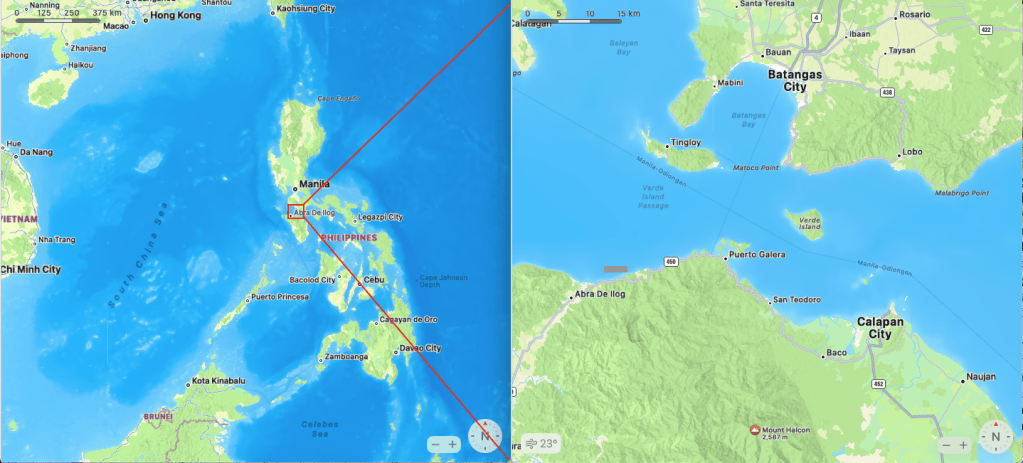
Source: Google Maps
Over the past decades, signs of strain have become more difficult to ignore. Fish stocks are widely reported to have declined, in some estimates by more than half (Boquiren, 2010). Coral reefs face increasing stress linked to rising sea temperatures. Mangroves and seagrass beds, which function as nurseries for fish and buffers against storm surges, continue to be degraded in parts of the Passage. At the global level, the IPCC (2022) has pointed to the accelerating warming and acidification of the oceans, trends that are already affecting tropical marine ecosystems. Projections suggest that even under moderate warming scenarios, coral survival becomes increasingly uncertain (WEF, 2024).
These shifts are often described in scientific terms. Along the coasts of the VIP, however, they are recognised through community experience.
Fishers speak of seasons that no longer behave as they once did. The timing of fish arrivals has become less predictable. Periods of abundance appear shorter. Species that were once commonly caught nearshore now require longer trips, greater fuel costs, and more time at sea. There is no single moment that marks this change. It accumulates, gradually, until it becomes part of everyday calculation.
Daily routines have adjusted accordingly. Some fishers leave earlier, well before dawn, to avoid the increasing heat later in the day. Others extend their hours or shift to night fishing. These are practical responses. They do not come with labels. Yet they reflect a process of ongoing adjustment to conditions that are no longer stable.

Source: Philippine Information Agency (2025)
On land, the changes are also visible. Residents describe high tides that reach further inland than they remember, occasionally flooding roads and homes. These observations align with broader patterns of sea level rise, though they are not always framed that way locally. They are simply understood as part of a changing environment.
The effects move through households in ways that are less visible but no less significant. Women who process and sell fish in local markets experience directly the variability of supply. When catch declines, income becomes uncertain. Decisions about spending, saving, and borrowing become more constrained. In many cases, adjustments are made quietly – reducing consumption, delaying expenses, finding alternative sources of income where possible.
Climate change, in this sense, is not experienced as a singular event. It is absorbed into the rhythms of livelihood and household management.
At the same time, the Passage has been undergoing another kind of transformation. Batangas, on the northern edge of the VIP, has become a focal point for energy infrastructure, including liquefied natural gas terminals and gas-fired power plants (Cabico, 2023). Maritime traffic remains dense, linking major economic centres. These developments are part of broader national strategies for energy security, maritime and transport networks, and economic growth. Their presence introduces another layer of complexity. The same waters that sustain small-scale fisheries also support industrial activity. The risks associated with these uses are not evenly distributed.
When environmental incidents occur – such as the oil spill that affected parts of Mindoro – fishing is often suspended. Assistance is provided to affected communities. For households that depend on daily catch, such assistance is critical. It provides immediate relief. At the same time, it raises questions that extend beyond the immediate response. Relief addresses the symptoms of disruption; it does not necessarily alter the conditions that make communities vulnerable to such disruptions in the first place (Ongcal, 2023).
This is where the broader political economy of the Passage begins to come into view. Fishing households are directly exposed to ecological variability and environmental shocks. Industrial actors operate within regulatory frameworks that extend beyond the local scale. Decisions about infrastructure, investment, and enforcement are made elsewhere, even as their consequences are felt locally.
Adaptation, in this context, takes multiple forms.
At one level, there are the adjustments that fishers make to continue their work under changing conditions – altering gear, changing fishing grounds, extending hours. These responses are often immediate and pragmatic. They allow livelihoods to continue, at least in the short term.
There are also more significant shifts. Some households move away from capture fisheries altogether, turning to aquaculture or relying on income from family members working in urban areas or overseas. These transitions can stabilise income, but they also signal a departure from traditional livelihood systems. Often they similarly face climate-related and other challenges.
Local governments have also acted. Marine protected areas have been established. Integrated Coastal Management initiatives have been introduced. Fisheries regulations have been strengthened in some municipalities. These efforts reflect recognition that the condition of marine ecosystems cannot be taken for granted.
These responses suggest that adaptation is not absent. It is present, and in many cases, active.
Yet when viewed across the scale of the Passage, a different picture begins to emerge. These efforts are often confined within municipal or provincial boundaries. They are shaped by local capacities, resources, and priorities. The ecological processes they seek to manage, however, extend beyond those boundaries.
This creates a form of fragmentation that is not immediately visible at the level of individual initiatives. A marine protected area may be well-managed within one municipality, while adjacent waters fall under different regimes. Enforcement may be strong in one area and weaker in another. Monitoring systems may not be harmonised. Data may not be shared. The result is not a lack of effort, but a lack of alignment.
This is where the question of scale becomes unavoidable. The Passage functions as an interconnected ecological system. Governance, for the most part, does not. The challenge, then, is not simply to encourage more adaptation. It is to understand how existing efforts relate to one another, and whether they can, over time, add up to something more than a patchwork of responses.
The distinction matters because not all forms of adaptation lead in the same direction. Some allow systems to persist under stress. Others involve more fundamental changes in how resources are managed and how decisions are made.
The possibility of such deeper change becomes clearer when we look more closely at how certain communities have responded. It is here that the experience of women and their communities in Bgy. Lagadlarin in Lobo becomes relevant – not as an exception, but as an indication of what may be emerging, and of the limits that they encounter.
Next: Part II – The case of Samahan ng Maliliit na Mangingisda sa Pangangalaga ng Kalikasan sa Barangay Lagadlarin (SMMNPKBL)
Part II: Women’s Stewardship and the Political Economy of Scaling Transformation
The first part of this discussion situates the Verde Island Passage (VIP) within a landscape of ecological stress and fragmented responses. The next one looks more closely at how adaptation takes shape in practice – and what happens when those practices begin to move beyond adjustment and toward something more structural.
In Barangay Lagadlarin, in the municipality of Lobo, Batangas, a community-led initiative offers one such point of entry. The organisation at the centre of this effort is the Samahan ng Maliliit na Mangingisda sa Pangangalaga ng Kalikasan sa Barangay Lagadlarin (SMMNPKBL), a group composed largely of local women who have taken on the stewardship of a mangrove ecosystem that has become both an ecological asset and a site of collective organisation.
The mangrove forest they manage covers roughly thirty hectares and is notable not only for its size but for its diversity, containing a significant proportion of the true mangrove species found in the Philippines. In ecological terms, it functions as a nursery for fish, a buffer against coastal erosion, a shield against storm surges, and a store of blue carbon. In social terms, it is a source of livelihood, as well as a focal point for community activity.
The origins of this initiative are not rooted in a formal programme or externally driven project. They can be traced to a local decision in 2014, when the punong barangay who was himself a fisher – began to demarcate a path through the mangrove area. The intention was simple: to encourage residents to see the mangrove forest not as an unused or peripheral space, but as something worth protecting and maintaining.
What followed was not immediate transformation, but a gradual process of participation. Residents joined in maintaining the pathway and started discouraging destructive and illegal practices of cutting mangrove trees for charcoal making. The barangay invested in an elevated walkway. Over time, what began as a conservation effort took on an organisational form. The group that would become SMMNPKBL emerged from this process, drawing in members who were already embedded in the local economy – many of them women engaged in fish processing, vending, and household management.
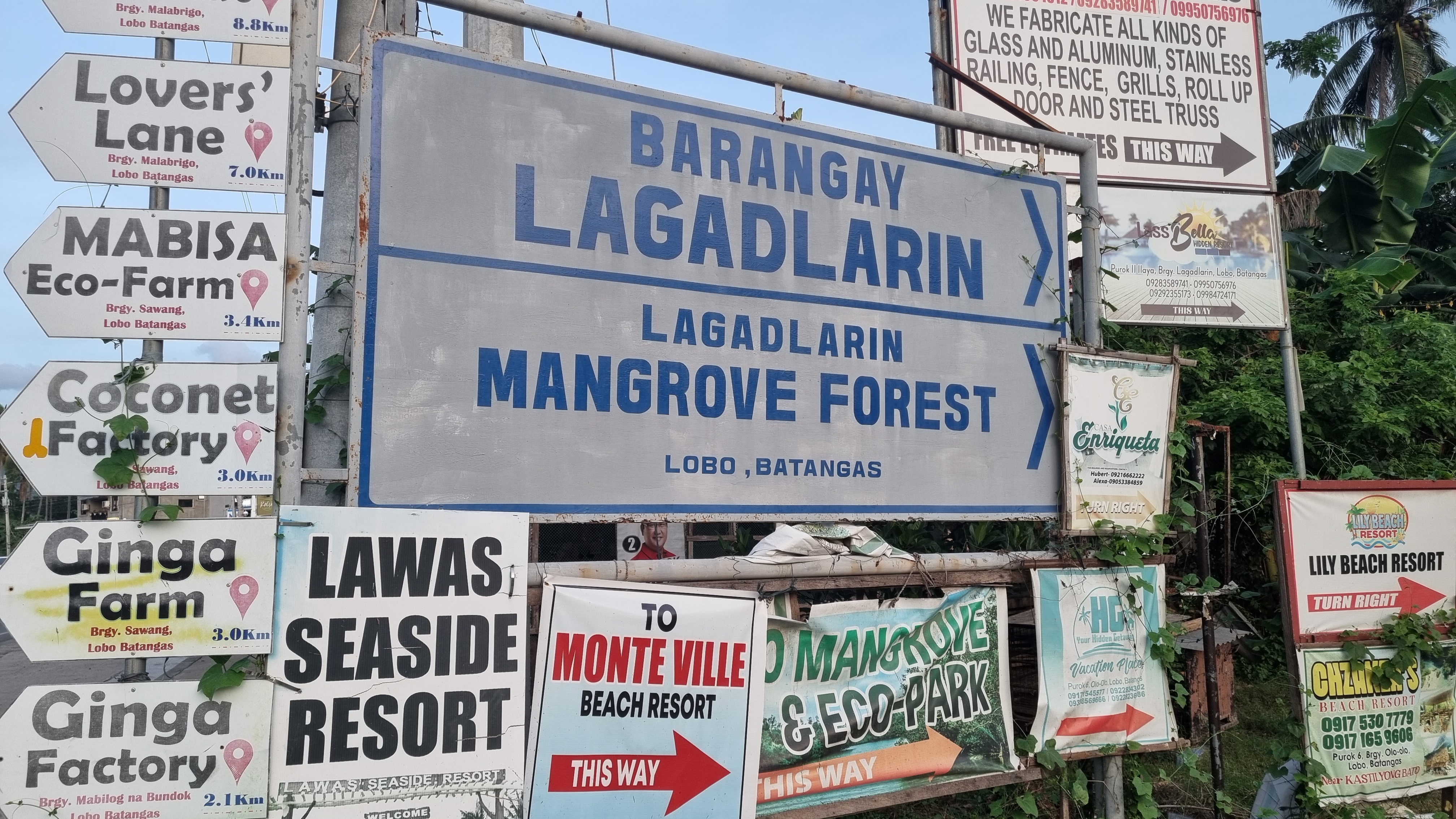

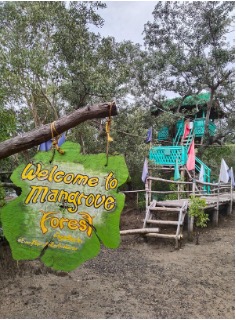
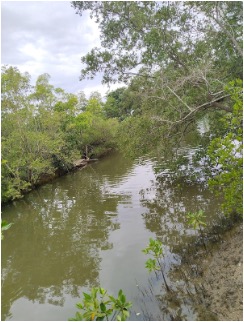
Images by Meng Abarquez and F. Perez
The shift from informal participation to organised activity did not happen in isolation from changing environmental conditions. Declining catch and increasing variability in fisheries meant that the connection between the health of the mangrove ecosystem and livelihood became more difficult to ignore. For those whose income depended on daily catch, the consequences were immediate. In this context, mangrove conservation was not framed as an abstract environmental concern. It was tied to the question of whether livelihoods could be sustained at all.
SMMNPKBL’s activities expanded accordingly. The group established a mangrove nursery, producing seedlings that could be sold to government agencies, private companies, and individuals required to participate in reforestation activities. They developed small-scale tourism facilities, including cottages and guided access through the mangrove area. They organised maintenance of the walkway and coordinated with local authorities on conservation-related matters.
These activities generated income, though not without limitations. A portion of the revenue from seedlings and services is retained by the organisation for maintenance and reinvestment, while the remainder is distributed among active members. At the same time, entrance fees to the mangrove eco-park are collected by the municipal government and the barangay. The organisation itself does not receive a share of these entrance fees, despite being responsible for the upkeep of the site. Their project of mangrove forest conservation and marine eco-park has won environmental conservation awards, but they never get a share of the prize money from the local government.
This arrangement is not presented locally as a point of conflict. It is, however, indicative of a broader pattern. The labour of conservation is organised at the community level. The formal channels of revenue collection are structured through local government. Recognition of the organisation’s role exists, but the alignment between responsibility and financial return remains partial.
What is more immediately visible is the way in which the organisation has altered the dynamics of participation and governance within the barangay.
Women, who are often positioned at the intersection of livelihood management and household decision-making, have become central actors in the stewardship of the mangrove forest. Their involvement extends beyond routine maintenance. It includes coordination with visitors, engagement with local authorities, and participation in discussions about resource use.
This shift has subtle but important implications. It broadens the scope of what is considered part of resource governance. Discussions that might otherwise focus narrowly on fish catch or enforcement begin to include questions of household stability, future livelihood options, and the long-term condition of the ecosystem. In this sense, the organisation does not simply implement conservation activities, but rather it reshapes how those activities are understood.
From the perspective of adaptation theory, these developments begin to approach what has been described as transformative adaptation (Pelling, 2010; Ziervogel, 2021). There is a discernible change in how environmental services and their limits are perceived, in how responsibilities are organised, and in how practices are sustained over time.
Yet it would be misleading to suggest that Lagadlarin represents a complete transformation.
The scope of the organisation’s influence remains largely within the barangay and, to some extent, the municipality. The mangrove area they manage is significant, but it is only one part of a much larger ecosystem. The conditions affecting fisheries, their livelihoods and their lives – currents, water quality, regional fishing pressure, and industrial activity – extend beyond their reach.
Financially, the organisation operates within tight constraints. While it generates income, it does not control the larger revenue streams associated with tourism or environmental fees. Access to national-level climate finance mechanisms, such as the People’s Survival Fund (PSF), remains limited by procedural requirements and administrative capacity.
Institutionally, the systems within which they operate remain fragmented. Monitoring of coastal ecosystems is not standardised across municipalities. Data is not always shared. Enforcement varies from one jurisdiction to another. The alignment between local initiatives and provincial or national strategies is, at best, uneven.
These constraints do not negate what has been achieved. They define its limits. Lagadlarin is not an isolated success story. It is an example of how far community-level organisation can go within existing structures – and where it begins to encounter boundaries that cannot be addressed locally.
Those boundaries are shaped by the same factors that define the broader political economy of the Verde Island Passage.
Decentralisation has given local governments authority over coastal management and, in many cases, the ability to generate revenue from environmental fees. This has enabled innovation. It has also created a landscape in which incentives are tied to jurisdictional control. Municipalities that have invested in conservation may be reluctant to enter into arrangements that dilute their (fiscal) autonomy.
Climate finance mechanisms exist, but they are not easily accessed by communities or even by some local governments. The technical requirements for proposals, the need for coordination across agencies, and the limited availability of support for proposal development all contribute to a situation in which resources do not always reach the areas where they are most needed.
At the same time, development trajectories – particularly those related to energy infrastructure – continue to shape the ecological context in which communities operate. Decisions about LNG terminals, shipping routes, and industrial facilities are made at scales far removed from barangay-level governance. Yet their implications are felt locally.
Within this landscape, the question of scaling becomes more complex than simply replicating what works in one place.
It is not enough to ask whether other communities can adopt similar practices. The more difficult question is whether the institutional environment can support the expansion of such practices in a way that is coherent across the ecosystem.
Lagadlarin suggests that transformation can begin from below. It also suggests that without alignment above, such transformation risks remaining limited.
The issue is not the absence of initiative. It is the conditions under which initiative can accumulate into something more than a patchwork of localised responses.
This brings the discussion back to the question of scale – not only ecological scale, but institutional scale – and to the forms of coordination and negotiation that would be required to bridge the two.
Next: Part III – Governing at the Scale of the Ecosystem: Institutional Alignment and Political Choice
Part III: Governing at the Scale of the Ecosystem – Institutional Alignment and Political Choice
(Posted: 28 April 2026)
The experience of the Verde Island Passage shows, quite clearly, that climate adaptation does not occur in isolation. It takes shape within institutional arrangements that determine what can be done, by whom, and at what scale. As the discussion moves from individual and community responses toward the question of system-wide resilience, adaptation can no longer be treated as a stand-alone issue. It becomes inseparable from governance.
What stands out is not a lack of effort. Across the Passage, municipalities have established marine protected areas, enforced fisheries regulations, and engaged in Integrated Coastal Management initiatives. Communities such as Lagadlarin have assumed stewardship roles that extend beyond what might have been expected of local organisations. At the national level, policies are in place and financing mechanisms have been established. The institutional architecture exists, at least on paper. Yet, the sense of fragmentation remains.
This has less to do with gaps in activity and more to do with how ecological processes relate to institutional arrangements. The Passage functions as a connected system. Fish stocks decline across municipal boundaries. Ocean acidification, sea level rise, and temperature rise do not stop at administrative lines. Governance, however, continues to be organised along those lines. Authority is distributed across municipalities, provinces, and national agencies, each operating within its own mandates, incentives, and constraints.
At the level of individual municipalities, progress can be observed. A marine protected area may be effectively managed. Enforcement may be sustained. Community participation may be strong. But these gains do not necessarily extend beyond the boundaries within which they are achieved. Adjacent areas may operate under different priorities or levels of capacity. Monitoring systems are not always aligned. Data is collected, but not consistently shared in ways that allow for a system-wide understanding of conditions.
This is often where “coordination” enters the discussion. The problem is framed as one of improving coordination – creating platforms, enhancing communication, aligning plans. These steps are not unimportant. They address real gaps. But they do not fully account for the underlying dynamics that shape how institutions behave.
Local government units operate within a decentralised system that gives them authority over coastal management and, in many cases, access to revenue streams derived from environmental fees and tourism. These revenues are not incidental. They form part of local fiscal structures and, by extension, local political accountability. Municipalities that have invested in conservation and enforcement have done so partly because they are able to retain the benefits of those investments.
Seen from this perspective, the question of ecosystem-scale governance becomes more complicated. It is not simply a matter of aligning plans. It raises the issue of how benefits are shared.
Proposals to declare the Verde Island Passage as a protected seascape recognise the need for governance arrangements that better reflect ecological reality. At the same time, they bring into view concerns about revenue-sharing, authority, and control. For municipalities that have built their own systems, integration into a broader framework can be interpreted not only as an opportunity for coordination, but also as a potential loss of autonomy. This is not resistance to conservation. It is a response to how incentives are structured.
If governance at the scale of the ecosystem is to move beyond aspiration, these incentives have to be addressed directly. Creating coordinating bodies or mandating alignment will not be sufficient on their own. The more difficult question is how participation in such arrangements becomes viable for those who operate within them. This inevitably brings fiscal considerations to the centre of the discussion.
An ecosystem-scale framework would need to recognise existing investments made by municipalities while creating ways for benefits to be shared without undermining local revenue bases. This could involve pooled funds, performance-based transfers, or other arrangements that reward effective stewardship while supporting coordination. The specific design may vary, but the underlying principle is difficult to avoid: ecological alignment depends on fiscal alignment. Without it, coordination remains uneven and largely voluntary.
A similar pattern can be seen in relation to climate finance. The People’s Survival Fund was created to support local adaptation initiatives, reflecting a recognition that climate risks require dedicated resources. In practice, however, access to these funds has been limited. Requirements for proposal development, technical documentation, and inter-agency coordination create barriers that not all local governments can easily navigate.
For communities such as those in Lagadlarin, the existence of climate finance does not automatically translate into support. The gap is not simply administrative. It reflects a mismatch between how funding mechanisms are structured and how local adaptation processes unfold.
If climate finance is to contribute to scaling adaptation, it will need to engage more directly with these realities. This may involve identifying priority areas more proactively, supporting proposal development, and enabling multi-municipal initiatives rather than treating projects as isolated interventions. It also calls for a shift in how outcomes are understood – from discrete project outputs to contributions to system-wide resilience.
The question of accountability introduces another dimension. Environmental incidents, such as oil spills, make visible the limits of existing arrangements. Immediate responses tend to focus on containment and relief. These are necessary. They address urgent needs. But they do not necessarily alter the conditions that allowed such incidents to occur or that shape their impacts.
Communities affected by these events often receive assistance. At the same time, questions of liability, enforcement, and long-term remediation remain less prominent. Where relief consistently substitutes for accountability, the incentives for prevention may remain weak.
In a setting where industrial activity and ecological vulnerability coexist, governance cannot afford to treat these as separate domains.
This is where the broader development model becomes relevant. The expansion of energy infrastructure in Batangas is part of a national strategy, linked to decisions about investment, energy security, and growth. These decisions are made across sectors and levels of government. They do not sit neatly within the framework of coastal resource management.
Yet their implications are felt within the Passage.
For small-scale fishing communities, the relationship to these decisions is indirect. They do not determine where infrastructure is located or how it is regulated. They experience the consequences when ecological conditions shift or when disruptions occur. This asymmetry is part of the political economy of adaptation.
It is also where questions of climate justice take on a more immediate form. While climate justice is often framed in global terms—between countries that contribute differently to emissions and face different levels of risk—similar questions arise within the Passage itself. Who bears the costs of ecological degradation? Who benefits from development? Who participates in decision-making?
Fishing households, particularly those with limited alternatives, are directly exposed to environmental variability. Women, as noted earlier, often absorb these pressures within household economies. Industrial actors operate within broader regulatory frameworks that shape their responsibilities. Recognising these dynamics does not require adopting a single framework of justice, but it does require acknowledging that adaptation is not neutral. It redistributes risk and opportunity.
Returning to the question of scale, the experience of Lagadlarin can be read in this light. The organisation has shown that collective stewardship is possible and that local institutions can evolve. At the same time, it operates within a system that limits how far these efforts can extend.
Scaling such initiatives is not simply a matter of replication. It involves creating conditions in which similar forms of organisation can emerge and be sustained across different contexts, while also ensuring that they are connected to broader governance frameworks.
This is where the idea of governing at the scale of the ecosystem becomes more concrete. It does not imply a single authority controlling the Passage. Rather, it points to a set of arrangements through which different levels of governance – barangay, municipal, provincial, and national – can align their actions in ways that reflect ecological interdependence. It requires mechanisms for sharing information, coordinating enforcement, and aligning incentives, as well as processes for addressing disagreements.
None of this removes the need for political choice. Decisions about revenue-sharing, authority, and accountability involve trade-offs. Municipalities may weigh the benefits of coordination against the risks to their autonomy. National agencies may balance competing sectoral priorities. Industrial actors may respond to changes in regulatory expectations.
The movement toward coherence is unlikely to be straightforward. It will involve negotiation, adjustment, and, at times, contestation.
What the Verde Island Passage makes clear is that the alternative – continuing along a path of fragmented adaptation – carries greater risks. Efforts may continue and even expand. But without alignment, their cumulative effect may fall short of what is required to sustain the ecosystem and the livelihoods that depend on it, and to respond meaningfully to climate change.
The Passage remains a place of remarkable ecological richness. It is also a place where the limits of existing governance arrangements are becoming more visible. Whether it becomes a site of systemic resilience or of continued strain will depend on how these limits are addressed.
The challenge is not only to adapt to a changing environment. It is to organise governance in a way that recognises the interconnected nature of that environment, across scales and across institutions.
That is not a problem to be resolved once. It is an ongoing and difficult political process.

