Much of the discussion surrounding the Philippine opposition’s electoral defeats—particularly after 2022—has revolved around the perceived reluctance of Vice President Leni Robredo to seek or sustain national leadership. Robredo’s hesitation may have mattered tactically, but it was never the central problem. The more consequential failure lies deeper: in the opposition’s chronic lack of long-term political preparation, its episodic and reactive approach to electoral politics, and its inability to articulate and institutionalise a coherent national development project capable of sustaining power beyond moments of crisis.
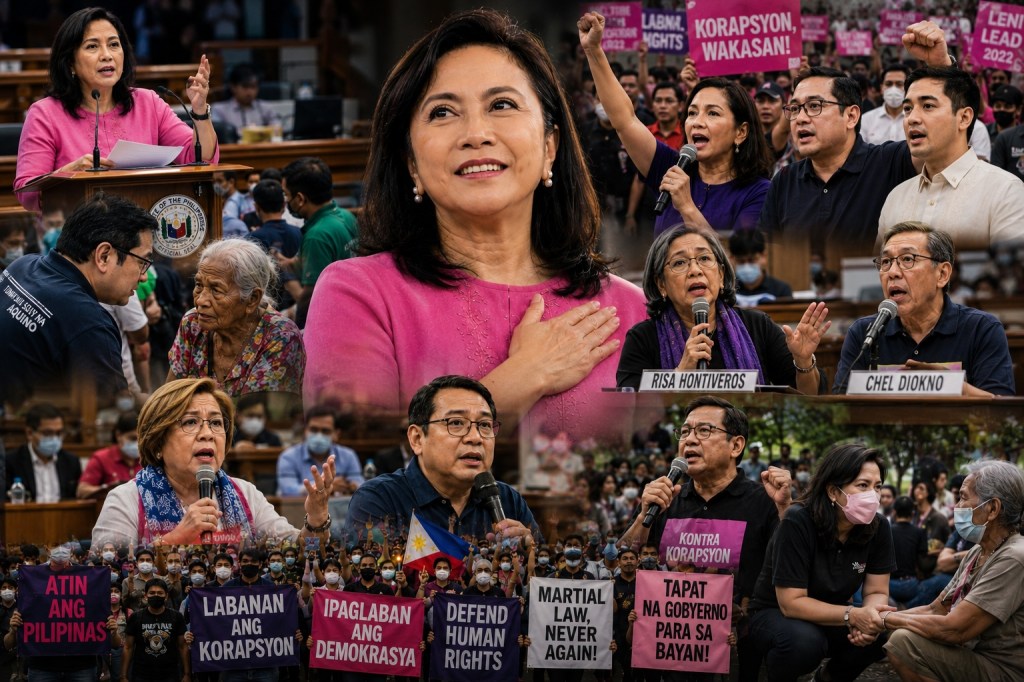
The challenge confronting the opposition is not simply the absence of a charismatic presidential contender, but the absence of a durable political machinery, a sustained organisational ecosystem, and a compelling political-economic vision capable of attracting long-term investment, loyalty, and social constituency-building across classes and regions.
The Marcos restoration did not emerge from historical inevitability, nor from mere nostalgia. It was the outcome of nearly four decades of disciplined political reconstruction following the family’s ouster in 1986. From the moment Ferdinand Marcos fled Malacañang, the Marcoses treated political rehabilitation as a continuous and intergenerational project. They rebuilt provincial bailiwicks in Ilocos, preserved congressional footholds through successive electoral victories, cultivated relationships with entrenched political clans, embedded themselves within shifting elite coalitions, and—perhaps most decisively—invested heavily in a digital and cultural ecosystem that gradually reframed historical memory for a new generation.
The eventual Marcos-Duterte alliance was the culmination of years of patient political consolidation, regional alliance-building, and strategic positioning. The Uniteam formula effectively combined the Marcos machinery in Northern Luzon with Duterte influence in Mindanao, while making significant inroads into the Visayas. It transformed fragmented dynastic influence into a national electoral juggernaut.
The opposition, by contrast, has largely operated through an ad hoc politics of resistance rather than a sustained politics of power-building. Coalitions are repeatedly assembled at the last possible moment, often driven more by immediate electoral necessity than by coherent ideological or programmatic alignment. Signals sent to potential allies are frequently inconsistent: unity is invoked rhetorically while rival candidacies are entertained informally; democratic reform is promised, yet local machinery-building remains weak; broad coalitions are sought, but long-term political integration rarely materialises.
Even where financial support potentially exists—from segments of the business sector, overseas Filipinos, reform-oriented networks, civil society organisations, and progressive constituencies—the opposition often arrives too late to consolidate these resources into a coherent and sustained political infrastructure. By the time national candidacies are formalised, resources, loyalties, and local alliances have frequently already migrated elsewhere.
This is not merely a tactical weakness. It reflects a deeper structural problem in the way opposition politics has evolved in the Philippines. Electoral mobilisation remains heavily candidate-centric and episodic, rather than institutional and continuous. Political engagement intensifies during election cycles, then dissipates afterward. Party-building remains weak, regional expansion inconsistent, and leadership development thin beyond a small circle of nationally recognisable personalities.
The Liberal Party, in particular, has struggled to transform itself into a genuinely national, mass-based political organisation capable of sustained grassroots consolidation outside its traditional areas of strength. It has not invested sufficiently in building second- and third-tier leadership across regions where it remains electorally vulnerable. Nor has it systematically cultivated a new generation of nationally viable political figures capable of carrying a long-term democratic reform agenda beyond the Aquino-Robredo political lineage.
The result is both a leadership vacuum and a broader crisis of political reproduction. At the heart of this weakness is the absence of a compelling and sustained national development agenda capable of functioning as the anchor for long-term political investment and coalition-building. The opposition has often defined itself primarily in relation to what it opposes—corruption, authoritarianism, disinformation, impunity—rather than through a deeply articulated and socially embedded programme for national transformation.
Yet democratic resistance alone is rarely sufficient to sustain long-term political mobilisation, particularly in contexts marked by persistent inequality, regional disparities, elite capture, vulnerability, and deep public frustration over everyday economic insecurity.
What is needed is not the replication of the Marcoses’ motivations. The Marcos political project was fundamentally rooted in dynastic restoration, historical revisionism, and the recovery of state power lost in 1986. The opposition cannot and should not derive its coherence from the same impulse. Its challenge is fundamentally different: to construct a progressive and credible national project capable of linking democracy with material transformation, institutional reform, and social justice.
Such a project must move beyond abstract liberalism and articulate a concrete and integrated political, economic, and social vision for the country.
Politically, this would require a sustained commitment to democratic deepening: institutional accountability, rule of law, protection of civil liberties, press freedom, electoral reform, and accountability for human-rights violations. But these democratic commitments must also be connected to material questions of governance and public welfare.
Economically, the opposition must articulate a development framework that addresses structural inequality rather than merely managing it. This includes progressive taxation, labour protection, industrial and agricultural revitalisation, anti-monopoly regulation, food security, strategic economic sovereignty, and a more equitable distribution of development gains across regions and sectors.
Socially, it requires a serious commitment to universal healthcare, quality public education, social housing, climate resilience, environmental justice, and social protection systems capable of addressing both chronic poverty and emerging vulnerabilities associated with economic instability and climate change. Even national sovereignty issues—such as the defence of the West Philippine Sea—must be situated not only within geopolitical discourse but within broader questions of democratic accountability, resource security, and national dignity.
Without such a programme, opposition politics risks remaining personality-driven and emotionally reactive rather than structurally transformative.
A coherent national agenda matters not only because it clarifies policy direction. It also creates the conditions for long-term political investment. Donors, reform-oriented business sectors, grassroots organisers, civil society actors, youth movements, labour groups, local political leaders, and ordinary citizens are more likely to invest sustained resources and commitment when they see not merely an electoral campaign, but a viable and enduring political project.
The Robredo Paradox
Most Philippine political families enter politics because politics is their family business. Office, influence, and dynastic continuity are part of a single project. Children are prepared for succession. Family identity becomes intertwined with political power. Withdrawal from politics is therefore not a neutral choice but a loss of influence, status, and access. The Robredos do not fit comfortably into that model.
Leni Robredo’s political journey appears inseparable from Jesse Robredo’s legacy of public service. Yet that same legacy was never about building a dynasty. It was about governance, reform, and service. The result is a curious tension. The family carries a moral and political legacy that many supporters feel should continue to find expression in public leadership, but they do not appear to possess the dynastic instinct that typically drives political families to perpetuate themselves in power. That tension may explain much about the current moment.
In many ways, the Robredos embody two competing impulses. On one hand is the imperative of continuing a public-service tradition that began with Jesse Robredo and that many Filipinos now associate with integrity, competence, and democratic governance. On the other hand is an equally understandable desire to live meaningful, productive, and fulfilling lives beyond politics. The family has already paid a steep price in service to the nation. Jesse Robredo’s death while serving in government is a constant reminder that public office carries costs that extend far beyond elections and political attacks.
Unlike political dynasties that seek to preserve power across generations, the Robredos seem uniquely positioned to walk away from politics altogether. Their daughters have established their own academic and professional identities. They are strongly positioned for public service, but none appears to have been groomed for political succession. Their family’s future does not depend on retaining public office. Yet it is precisely because they are not a dynasty that many Filipinos continue to see them as an authentic alternative to dynastic politics.
This is the paradox of the Robredos. The very qualities that make them attractive to many reform-minded Filipinos and deserving of leadership position—their apparent lack of dynastic ambition, their rootedness outside politics, and their ability to lead lives independent of public office—are also the qualities that make it difficult to assume they will remain in politics indefinitely.
For the opposition, this paradox carries an uncomfortable lesson. If the future of democratic reform depends heavily on a family that has repeatedly demonstrated its willingness to leave politics behind, then the problem is not the family. The problem is the opposition’s failure to develop institutions, leaders, and movements capable of carrying that legacy forward without relying on the continued sacrifice of the Robredos themselves.
When Robredo finally committed to the 2022 presidential race, she inspired one of the most remarkable volunteer-driven mobilisations in contemporary Philippine political history. The pink movement demonstrated extraordinary levels of grassroots energy, civic participation, youth engagement, and decentralised volunteerism across the country. That mobilisation was not the product of organisational coercion or dynastic machinery. It reflected genuine public yearning for an alternative political future.
Yet the movement also exposed the limits of charisma and moral legitimacy in the absence of equivalent long-term organisational infrastructure. Enthusiasm alone could not compensate for decades of machine-building, alliance consolidation, narrative warfare, and political financing accumulated by rival political forces.
In this sense, Robredo’s reluctance is politically significant not because it proves unsuitability for leadership, but because it reflects a broader tension within reform-oriented politics itself: the persistent underestimation of the extent to which democratic politics also requires continuous power-building, strategic endurance, and organisational consolidation.
From a purely strategic opposition standpoint, her decision not to contest the presidency in 2028—despite surveys indicating a potentially competitive race and despite the absence of another opposition figure with comparable national recall, legitimacy, and mobilising capacity—inevitably deepens the leadership vacuum confronting the democratic opposition. Senator Kiko Pangilinan’s concerns about this vacuum are therefore not exaggerated. They reflect a structural reality.
But the responsibility for that vacuum cannot be placed on Robredo alone. She is also a product of a broader opposition ecosystem that has repeatedly failed to institutionalise its gains, consolidate its movements, and sustain political engagement beyond electoral moments. The opposition has not built the organisational, financial, ideological, and territorial infrastructure required for a long political struggle. Nor has it fully internalised the hard lesson that the Marcoses understood decades ago: political power is not won only during campaigns; it is accumulated continuously through organisation, narrative construction, alliance maintenance, constituency-building, and institutional endurance.
The central issue, therefore, is not whether Robredo is “fit” for the presidency. The deeper question is whether the opposition is finally prepared to treat politics as a permanent vocation rather than an episodic reaction to democratic crisis.
The Marcoses succeeded not only because they worked harder—though in many respects they did—but because they approached politics as a generational project requiring patience, discipline, strategic flexibility, and relentless investment in political infrastructure.
The opposition continues, too often, to approach politics as a recurring emergency to be managed periodically.
Until this changes, electoral cycles will continue to expose the same structural weaknesses: fragmented coalitions, inconsistent messaging, weak regional machinery, shallow leadership benches, underdeveloped political institutions, and the absence of a unifying national programme capable of binding together diverse democratic constituencies over the long term.
The challenge confronting the opposition today is therefore far larger than the candidacy of any single individual. It is the challenge of constructing a credible, progressive, and deeply rooted national development project that Filipinos can believe in, invest in, and sustain politically over decades rather than electoral seasons.
Without such a transformation, reluctance will continue to appear as the central problem when, in reality, it is merely one manifestation of a much deeper crisis: the opposition’s continuing failure to prepare systematically, organise continuously, articulate a transformative vision, and remain embedded in the long game of democratic politics.
The stakes extend far beyond electoral victory. They concern the future character of Philippine democracy itself.

