If the first instalment of this series challenges simplified narratives of EDSA, and the second instalment traces the uneven and contested trajectories that followed, then the question that remains is not whether EDSA succeeded or failed, but how it should be situated within a longer process of transformation—one that remains unfinished.
To see EDSA only as a triumph is to overlook its limits. To see it only as a failure is to ignore what it made possible. A more grounded view is to recognise it as a milestone: a decisive moment that altered the political landscape, but did not ensure a transformative direction of what would come next.
What EDSA restored was political space—the possibility of contestation, participation, and institutional rebuilding. What it did not resolve were the deeper structures that shape inequality, exclusion, and the concentration of power. These were carried forward into the post-EDSA period, where they interacted with shifting domestic and global conditions in ways that produced both gains and contradictions.
The decades that followed revealed both the potential and the limits of liberal democratic governance. Institutions were rebuilt, elections were held, and periods of economic growth were achieved. Yet these advances did not consistently translate into structural transformation. Inequality persisted, public services remained uneven, and accountability mechanisms were often constrained by entrenched interests. Over time, this gap between institutional form and lived experience contributed to erosion of trust.
It is within this context that the appeal of populist politics can be more clearly understood. As discussed earlier, populism did not emerge in isolation; it drew from accumulated frustrations, unanswered questions, and a growing sense of betrayal (real and imagined). At the same time, it reshaped those grievances into simplified narratives and immediate promises that often bypassed institutional safeguards. The result was not a resolution of underlying issues, but a reconfiguration of how they were expressed and acted upon, and in most occasions, the further entrenchment of those exact same issues.
This dynamic was further intensified by changes in the broader information environment. The increasing role of digital platforms in shaping public discourse has altered how history is remembered and contested. Narratives about both the EDSA People Power Revolution and the Marcos dictatorship have been reframed, circulated, and, at times, distorted in ways that blur the line between historical record and political messaging. Memory itself has become part of the terrain of political struggle.
At the same time, the conditions within which the Philippines operates have changed significantly. The global environment is more complex and more volatile than it was in 1986. The rise of China as a major economic and geopolitical actor, tensions in the West Philippine Sea, and the broader reconfiguration of global power have introduced new pressures that intersect with domestic governance challenges.
Perhaps more fundamentally, the nature of the challenges themselves has evolved. Climate change is no longer a distant concern but an immediate and intensifying reality, affecting livelihoods, ecosystems, and economic stability. Persistent poverty and inequality remain, but are now compounded by new forms of vulnerability. At the same time, democratic systems around the world—including liberal democracies—are under strain, facing questions about their capacity to respond effectively to complex, fast-moving crises.
Taken together, these developments suggest that the task ahead is not simply to defend or reject the legacy of EDSA, but to build on it with a clearer understanding of both its possibilities and its limits.
This requires, first, a more honest reckoning with the past. Recognising EDSA as a milestone allows for a more balanced assessment—one that acknowledges its role in restoring democratic space, while also examining why deeper transformation proved more difficult to achieve. It also requires confronting the ways in which political narratives have been simplified, polarised, or instrumentalised over time.
Second, it calls for renewed attention to the question of collective agency. The fragmentation of progressive forces, as noted earlier, limited the capacity to sustain pressure for structural reform. Moving forward will depend not on the reassertion of singular leadership, but on the ability to build broader, more inclusive coalitions that can engage both institutions and communities. This is less about ideological uniformity than about shared commitments to equity, accountability, and inclusion.
Third, it requires rethinking the relationship between national and global challenges. Issues such as climate change, economic inequality, and geopolitical tension operate beyond national boundaries. Responses to these challenges will need to be similarly interconnected, combining domestic reform with regional and global engagement. The Philippines’ experience is part of a wider set of transitions affecting many societies, each grappling with similar tensions between growth, equity, governance, and sustainability.
More fundamentally, it raises a question about the direction of political development itself. If the past four decades have shown the limits of both technocratic reform and populist reaction, then the work ahead may lie in finding ways to move beyond this binary—toward approaches that are both structurally grounded and responsive to lived realities.
At a time when the world appears increasingly fragmented—marked by rising authoritarian tendencies, deepening geopolitical competition, and uneven responses to global crises—the need for collective action becomes more urgent. The challenges facing the Philippines are not isolated; they are part of a broader set of existential risks that require cooperation across societies and across borders.
The unfinished nature of EDSA is not only a national condition, but part of a wider global process. The struggle to build more just, inclusive, and resilient systems is ongoing, and its outcomes remain uncertain.
EDSA did not complete that work. It created the conditions in which it could continue. What remains is the question of how those conditions are used—how political space is engaged, how institutions are strengthened or reshaped, and how collective action is mobilised in response to evolving challenges.
Forty years on, the task is not to return to EDSA as a moment, but to carry forward what it has taught us—more consciously, more critically, and with a clearer sense of what transformation requires.
Rethinking EDSA, Governance, and the Politics of Memory
One of the more persistent distortions in contemporary narratives about EDSA is the claim that a single political bloc—often caricatured as the “dilawans”—monopolised power and steered the country in a uniform direction in the decades that followed. A closer, historically grounded examination does not sustain this claim. The post-EDSA period is better understood not as a continuum of ideological control, but as a sequence of distinct administrations, each shaped by different political coalitions, governing philosophies, and historical constraints.
The presidency of Corazon Aquino was defined less by ideological consolidation than by political restoration. It brought together a broad and inherently fragile coalition—ranging from reform-oriented elites and segments of the Catholic Church to elements of the military and civil society actors united primarily by opposition to authoritarian rule. Aquino’s leadership was marked by moral authority rooted in the anti-dictatorship struggle, but this did not translate into a coherent program for structural transformation. Her administration faced persistent destabilisation, including multiple coup attempts, as well as pressures from competing constituencies with divergent expectations. The Mendiola massacre highlighted the tensions between reformist aspirations and entrenched interests, particularly in relation to land reform and social justice. In this sense, the Aquino government functioned as a transitional regime—reopening democratic space while leaving many structural questions unresolved.
The administration of Fidel V. Ramos marked a shift toward consolidation and technocratic governance. Ramos, drawing on his military background and pragmatic political approach, sought to stabilise institutions and reposition the Philippines within a rapidly globalising economic order. His administration emphasised market-oriented reforms, deregulation, and infrastructure development, alongside efforts to resolve long-standing internal conflicts through negotiated peace processes. Politically, Ramos operated through coalition-building rather than ideological alignment, assembling a broad base of support that cut across traditional party lines. His project was less about ideological transformation than about restoring confidence—in governance, in markets, and in the state’s capacity to function. However, the limits of this approach became evident during the Asian Financial Crisis, which exposed underlying vulnerabilities in the economic model.
The presidency of Joseph Estrada introduced a different political dynamic. Estrada’s rise was grounded in populist appeal, drawing support from lower-income sectors through rhetoric that positioned him as a representative of the “masa.” Unlike his predecessors, Estrada’s legitimacy was not anchored in institutional reform or technocratic competence, but in a direct connection with marginalised constituencies. However, this political style did not translate into a coherent governance framework. His administration was marked by inconsistencies, internal divisions, and allegations of corruption that ultimately led to his ouster. Estrada’s presidency revealed both the political potency of populist mobilisation and its limitations when not supported by institutional coherence or policy depth.
The administration of Gloria Macapagal Arroyo combined elements of technocratic governance with a highly contested political foundation. Arroyo’s ascent to power, following Estrada’s removal, was framed as a constitutional transition but remained politically polarising. Her administration focused on macroeconomic stabilisation, fiscal reforms—most notably the expansion of the value-added tax—and efforts to sustain economic growth in a challenging global environment. Arroyo’s governing style was characterised by a strong emphasis on executive control and political survival, often relying on strategic alliances and institutional manoeuvring. While her tenure delivered measurable economic gains, it was persistently overshadowed by questions of legitimacy, including allegations of electoral manipulation. This duality—economic performance alongside political contestation—became a defining feature of her administration.
The administration of Benigno Aquino III is often invoked as emblematic of so-called “liberal” rule, representing a return to a reform-oriented, institution-focused approach. Anchored in a platform of anti-corruption and good governance, Aquino’s administration sought to rebuild public trust in state institutions and improve fiscal management. His leadership drew on a narrative of moral renewal linked to his family’s association with the anti-dictatorship movement. Yet even here, the picture is more complex.
Economically, the period was marked by strong growth, improved credit ratings, and increased investor confidence. The administration emphasised institutional reform, anti-corruption, and fiscal discipline, achieving macroeconomic gains and international confidence. At the same time, these gains unfolded within a broader global framework shaped by neoliberal economic principles, which prioritised market efficiency and growth but proved insufficient in addressing entrenched inequality and structural imbalances. Economic expansion did not automatically translate into equitable distribution, leaving underlying social tensions unresolved. While the emphasis on institutional reform was significant, it did not fully address deeper questions of inequality and exclusion.
Taken together, these administrations reflect a pattern of divergence rather than continuity. They were shaped by different political affiliations, leadership styles, and governing priorities. To reduce them to a single ideological bloc is to overlook the complexity of the post-EDSA period and obscure the varied ways in which governance was pursued under changing conditions. Collapsing these administrations into a single, continuous “dilawan” project is therefore analytically untenable—it simplifies a far more complex political trajectory into a convenient but misleading narrative.
At the same time, the landscape of progressive politics was undergoing its own transformation. The Left, which had been a significant force in the anti-dictatorship struggle, entered the post-EDSA period already weakened by internal conflicts—marked by ideological divisions, rectification campaigns, and violent purges that eroded cohesion and trust. These dynamics extended beyond internal organisational concerns, affecting relationships with other actors in the broader social movement.
In the years that followed, this fragmentation did not simply result in pluralism. It often translated into competition and distrust. Certain sections of the hard-line Left, seeking to recover lost ground and reaffirm historical leadership, attempted to reassert ideological authority over the broader movement. Rather than consolidating alliances, these efforts frequently deepened divisions. Other progressive groups—church-based organisations, NGOs, and emerging civil society formations—responded with caution or resistance, shaped by earlier experiences of exclusion or confrontation. What might have evolved into a broad, adaptive coalition instead became a landscape marked by contested legitimacy and limited coordination.
These internal dynamics significantly constrained the capacity of progressive forces to influence the direction of the post-EDSA transition. At a moment when institutional reform, redistribution, and social justice required sustained and coordinated pressure, fragmentation diluted collective agency. The result was not the absence of reform, but its unevenness—partial advances alongside persistent structural inequalities.
At the same time, the Philippines was navigating a rapidly changing regional and global context. The post-Cold War period gave way to new configurations of power, among them the rise of China as a major economic, political, and military actor. This shift enabled more assertive behaviour in contested spaces such as the South China Sea, where expansive and widely challenged claims intersected with the Philippines’ own territorial and sovereign interests. China’s growing influence also extended into economic and political spheres, shaping dynamics not only within the Philippines but across ASEAN.
These global shifts interacted with domestic trajectories. Liberal democratic governments operated within an international system increasingly shaped by neoliberal economic norms, while also confronting new geopolitical pressures. The space for national policymaking was therefore neither fully autonomous nor entirely constrained; it was negotiated within overlapping layers of global markets, regional power competition, and domestic political realities.
It is within this broader context—of uneven governance outcomes and fragmented social movements—that the conditions for populism took shape. Beneath the macroeconomic gains and institutional continuity, legitimate questions had been accumulating: why had liberal democratic governance struggled to address fundamental and institutional injustices? Why did inequality persist despite sustained growth? Why did reforms appear incremental in the face of urgent social needs?
The rise of Rodrigo Duterte can be understood as emerging from these unresolved tensions. His political appeal lay in his ability to articulate widely felt frustrations and to present himself as an alternative to what was perceived as a slow and ineffective system. Where previous administrations emphasised process, institutional safeguards, and gradual reform, Duterte offered a model of governance centred on immediacy and decisiveness.
At the same time, populism operates not only by responding to grievances, but by reshaping and exploiting them. It simplifies complex structural issues, identifies convenient targets, and offers solutions that appear direct and immediate but often bypass institutional safeguards. In the Philippine context, this dynamic was reinforced through the reframing of political identities. Those associated with liberal democratic governance were increasingly characterised as “disente”—a term that, rather than signifying civic responsibility, was recast as an indicator of elitism and detachment. This discursive shift allowed populist narratives to transform structural critiques into cultural and political divisions.
The governance approach that followed reflected these dynamics. Duterte’s administration sustained certain economic policies in its early years, while simultaneously redefining political practice through a greater reliance on executive authority. The brutal, bloody anti-drug campaign became a central expression of this approach. It was marked by widespread violations of fundamental human rights and raised grave concerns regarding due process and accountability. It can be understood ironically as a response—however deeply problematic—to longstanding frustrations with crime, corruption, inequality, and institutional inefficiency. Yet in promising immediate and forceful action, it also demonstrated the risks inherent in bypassing the very institutions designed to uphold justice.
Table 1: Comparative Socio-Economic Indicators Across Post-EDSA Philippine Administrations
Administration
Period Covered
Avg GDP Growth (%)
Poverty Incidence (%)
Inflation (avg %)
Unemployment (%)
Key Observations
Corazon Aquino
1986–1992
3.1
45.3 (1985) → 39.9 (1991)
11.2
8.7
Post-crisis recovery; macro instability early; high inflation and debt burden
Fidel V. Ramos
1992–1998
4.7
39.9 (1991) → 31.8 (1997)
7.6
8.4
Structural reforms; liberalisation; improved growth; Asian Financial Crisis impact
Severe contraction due to COVID-19; recovery uneven; poverty reversal
Notes
GDP Growth Source: World Bank World Development Indicators (constant prices, annual %) Averages computed as simple mean of annual growth rates within each administration period
Poverty Incidence Source: Philippine Statistics Authority official poverty statistics Figures represent closest available survey years (not annual averages) Not strictly comparable across decades due to methodology updates
Inflation (CPI) Source: PSA Consumer Price Index (annual averages) Based on prevailing base years per period
Unemployment Source: PSA Labor Force Survey Annual averages per administration period
Populism, in this sense, can be seen as both a product and an amplifier of unresolved tensions within the post-EDSA period. It draws on real grievances but channels them into forms of political action that may further complicate, if not totally hinder, the pursuit of justice and structural transformation. Its emergence underscores the need to examine not only the failures of governance, but also the conditions that make such political responses possible.
This process was further enabled—and accelerated—by the strategic use of digital platforms. Social media did not merely serve as a neutral channel for communication; it became an active arena where narratives were constructed, amplified, and contested. In this space, simplified and often distorted accounts of both the EDSA People Power Revolution and the Marcos dictatorship circulated alongside more complex historical interpretations. Over time, these narratives contributed to a reframing of public memory—blurring distinctions among documented history, revisionist accounts, and outright lies.
By repeatedly associating the post-EDSA period with failure and inefficiency, while simultaneously recasting the dictatorship (as well as populist, authoritarian rule) in more favourable or ambiguous terms, these narratives created an environment in which those political trajectories are readily legitimised. The persistence and scale of such messaging did not simply reflect public sentiment; it actively shaped it, reinforcing existing frustrations while manipulating them toward distorted political conclusions and actions.
In this context, the return of the Marcos family to national political prominence cannot be understood solely as a product of electoral dynamics. It reflects a longer process in which historical narratives, political dissatisfaction, and digital amplification intersected. The ability to reframe the past became part of the struggle over the present, illustrating how political outcomes are increasingly mediated not only by institutions and material conditions, but also by control over narrative and memory.
It is clear the post-EDSA period reveals neither a singular failure nor a unified project of governance. It is better understood as a contested and uneven trajectory—marked by institutional rebuilding, unresolved structural inequalities, political fragmentation, and shifting global conditions. Simplified narratives, whether celebratory or dismissive, fail to capture this complexity, as illustrated partly in Table 1 above. Difficult and persistent problems required complex and sustained responses. The challenge is not to replace one caricature with another, but to recognise how multiple trajectories—state, movement, and global context—interacted to shape the failures, limits, and possibilities of a post-EDSA Philippines.
Third and last instalment: Rediscovering our Revolution: Exploring ways forward.
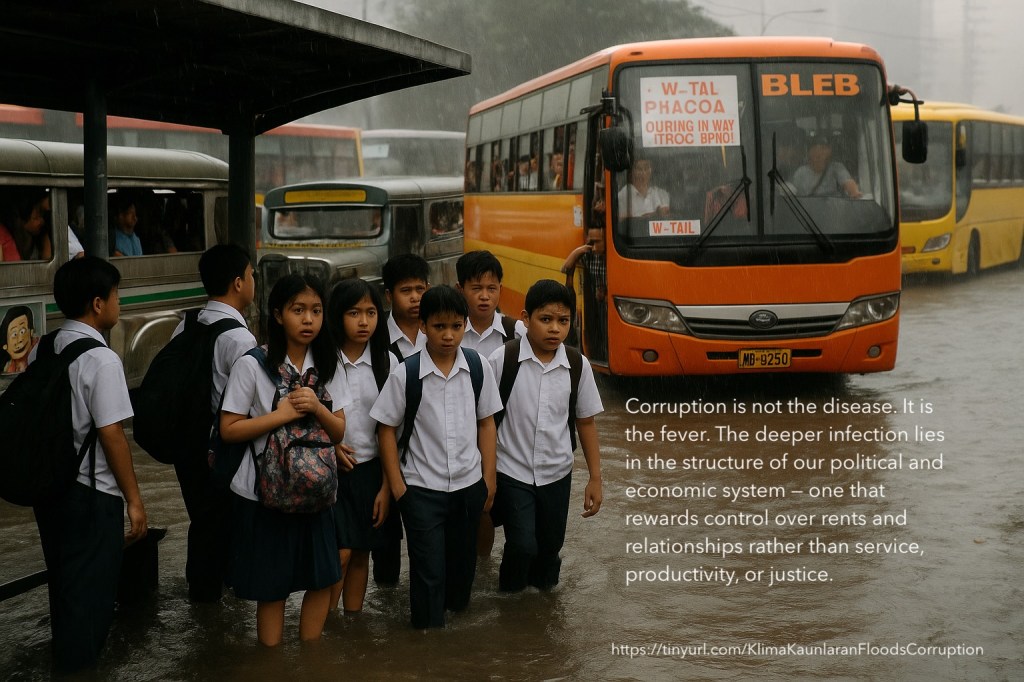
Every rainy season, Filipinos brace themselves for the same ordeal: flooded streets, stranded commuters, classrooms turned into evacuation centers, and homes filled knee-deep with murky water. According to the World Bank, more than 14 million Filipinos are exposed to flooding each year, with damages averaging ₱133 billion (≈US$2.4 billion) annually in lost assets, livelihoods, and productivity (World Bank, 2022).
Climate change is already magnifying this threat. PAGASA projects that extreme daily rainfall events will become more frequent, particularly in Luzon and the Visayas. At the same time, sea levels around the Philippines are rising at nearly double the global average — between 5.7 and 7.0 millimeters per year — making coastal flooding more frequent and destructive (World Meteorological Organization, 2023; PAGASA). Combined with rapid urbanization, clogged drainage systems, and the spread of informal settlements into floodplains, the current normal of yearly floods will only worsen unless the country embraces systemic change.
Citizenship and Culture: Demanding Change
For decades, citizens have been expected to “cope” with floods by stacking sandbags, raising furniture, or wading through waist-deep water. These coping mechanisms, repeated year after year, normalize disaster and shift responsibility to households that are often the least equipped to manage it. Resilience, however, must go beyond individual sacrifice.
True citizenship in the face of flooding means demanding transparency in how flood control budgets are spent. Billions of pesos are inserted into the General Appropriations Act every year for flood control projects, yet many are poorly built or never completed at all, as the Commission on Audit has repeatedly flagged. Civic groups, barangay councils, and homeowners’ associations can serve as watchdogs, pushing back against the entrenched culture of “budget insertions” that fuels corruption. At the same time, culture itself matters: reducing household waste that clogs drainage, participating in greening efforts, and embracing resilience as a shared responsibility all help ensure that solutions are not purely technical, but also social and cultural.
Floods are not inevitable acts of fate. They are failures of planning, governance, and accountability. Citizens have both the power and responsibility to demand more.
Governance: Protection
The governance failures in flood management are glaring. Between 2022 and 2024 alone, the government allocated ₱545 billion for flood control projects, yet many of these projects were later flagged as substandard, overpriced, or even non-existent (Reuters, 2025). Each year, the National Expenditure Program is transformed into the General Appropriations Act through budgetary “insertions” that inflate flood control allocations well beyond technical needs. Instead of protecting citizens, these projects too often become conduits for political patronage and private gain.
Shifting from pork to protection requires a new governance framework. Legislation must establish climate-resilient infrastructure standards, mandating underground floodwater reservoirs, expanded drainage networks, permeable pavements, and the integration of green infrastructure in all new developments. Urban planning must adopt a landscape approach that respects natural waterways, wetlands, and river basins, rather than building over them. Independent oversight bodies such as the Commission on Audit and the Ombudsman must be empowered to prosecute ghost projects and penalize both officials and contractors engaged in corruption. Finally, relocation and housing strategies must prioritize the poor, ensuring that informal settlers are not simply evicted from flood-prone areas but offered dignified, safe alternatives.
Without accountability and foresight, even the most sophisticated engineering projects will fail. Flood control must no longer be treated as a political prize but as a public necessity.
Private Sector: Innovation
The private sector occupies a complicated space in the story of floods. On the one hand, construction firms and contractors have too often been complicit in overpricing, license-renting, and ghost projects, benefiting from the very corruption that undermines public resilience. On the other, businesses also possess the expertise, technology, and resources that could drive innovative solutions.
For the private sector to shift from collusion to innovation, it must refuse participation in corrupt bidding schemes and commit to integrity in procurement. Developers can incorporate flood-resilient designs, including underground cisterns, elevated foundations, and permeable surfaces that reduce runoff. Partnerships with government could expand drainage systems, establish rainwater harvesting schemes, and invest in wastewater reuse, turning floodwater from a hazard into a resource. More fundamentally, businesses must see resilience not as a burden but as a market opportunity. Companies that lead in climate-resilient infrastructure will not only protect communities but also open new domestic and international markets. The cycle must change: from profits alone, to public good, and back again to market growth.
Learning from Models Abroad
The Philippines does not need to invent solutions from scratch. Other countries have faced similar threats and built models worth adapting. In Tokyo, the Metropolitan Area Outer Underground Discharge Channel is a vast system of tunnels and tanks that capture excess floodwater during storms. While prohibitively expensive at full scale, smaller underground cisterns beneath parks or intersections could be piloted in Manila or Cebu. In Singapore, the Marina Barrage functions as both a tidal barrier and a freshwater reservoir, while also serving as public space — a model of how infrastructure can combine resilience with livability. The Netherlands’ “Room for the River” program restores floodplains and wetlands, proving that giving rivers more space can sometimes be more effective than raising dikes. Bangkok’s “Monkey Cheek” reservoirs, where urban parks double as floodwater retention basins, offer a low-cost solution particularly relevant for dense Asian cities.
Philippine Pilots: Proof It’s Possible
Encouragingly, there are also homegrown examples that show resilience is possible when governance and citizen action align. Marikina City has developed a community-based flood warning system that provides real-time alerts, saving lives during typhoons. Iloilo has rehabilitated its river through mangrove replanting, clean-ups, and strict zoning enforcement, transforming a once-polluted waterway into a model of flood mitigation and urban renewal. Cebu has piloted rainwater harvesting systems in schools and barangays, demonstrating how small-scale innovations can reduce both flooding and water scarcity. Naga City has integrated participatory governance into its disaster planning, ensuring that citizens themselves are partners in shaping resilience strategies.
These local cases prove that innovation and accountability can make a tangible difference. The challenge lies in scaling them up and protecting them from the corruption that undermines so many other efforts.
Toward Flood-Proof Cities
Floods will never disappear entirely in a tropical archipelago like the Philippines. But the devastation we experience today is not inevitable. It is the result of political choices — to treat flood control as pork, to build on natural waterways, to neglect drainage, and to collude rather than innovate.
The path forward is equally a matter of choice. Citizens must refuse to normalize disaster and instead demand transparency. Governance must redirect flood control spending from patronage to protection. The private sector must move beyond collusion and embrace innovation as both duty and opportunity. And the Philippines must draw lessons not only from Tokyo, Singapore, the Netherlands, and Bangkok, but also from its own successes in Marikina, Iloilo, Cebu, and Naga.
Adapted, scaled, and protected from corruption, these models can move the country beyond sandbags and scandals — toward cities that protect lives, livelihoods, and dignity in the face of a changing climate.