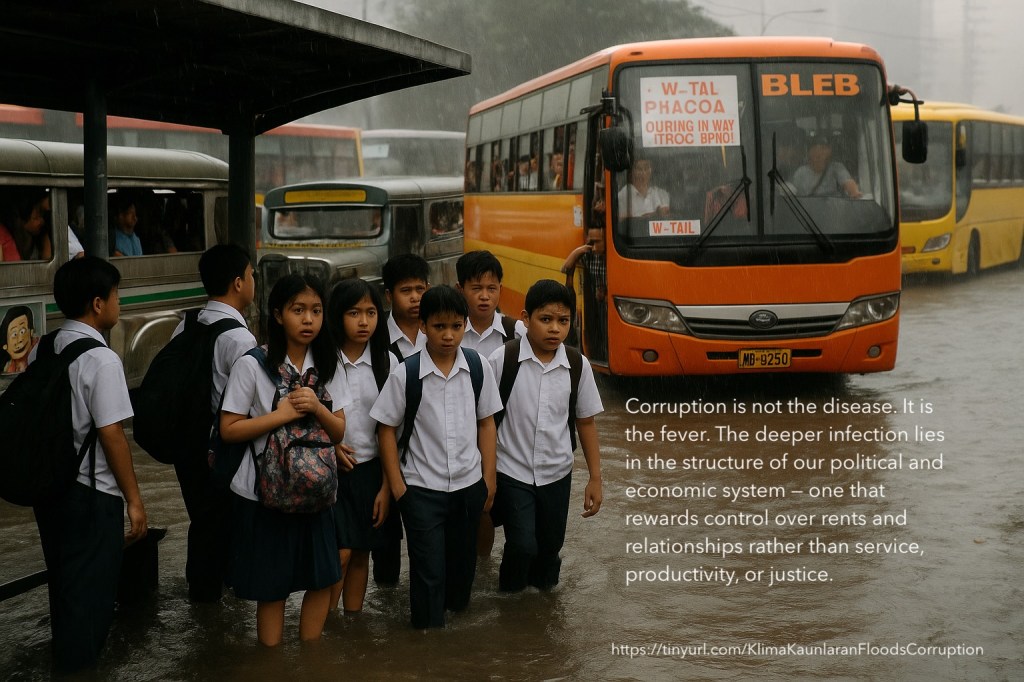
Every rainy season, Filipinos brace themselves for the same ordeal: flooded streets, stranded commuters, classrooms turned into evacuation centers, and homes filled knee-deep with murky water. According to the World Bank, more than 14 million Filipinos are exposed to flooding each year, with damages averaging ₱133 billion (≈US$2.4 billion) annually in lost assets, livelihoods, and productivity (World Bank, 2022).
Climate change is already magnifying this threat. PAGASA projects that extreme daily rainfall events will become more frequent, particularly in Luzon and the Visayas. At the same time, sea levels around the Philippines are rising at nearly double the global average — between 5.7 and 7.0 millimeters per year — making coastal flooding more frequent and destructive (World Meteorological Organization, 2023; PAGASA). Combined with rapid urbanization, clogged drainage systems, and the spread of informal settlements into floodplains, the current normal of yearly floods will only worsen unless the country embraces systemic change.
Citizenship and Culture: Demanding Change
For decades, citizens have been expected to “cope” with floods by stacking sandbags, raising furniture, or wading through waist-deep water. These coping mechanisms, repeated year after year, normalize disaster and shift responsibility to households that are often the least equipped to manage it. Resilience, however, must go beyond individual sacrifice.
True citizenship in the face of flooding means demanding transparency in how flood control budgets are spent. Billions of pesos are inserted into the General Appropriations Act every year for flood control projects, yet many are poorly built or never completed at all, as the Commission on Audit has repeatedly flagged. Civic groups, barangay councils, and homeowners’ associations can serve as watchdogs, pushing back against the entrenched culture of “budget insertions” that fuels corruption. At the same time, culture itself matters: reducing household waste that clogs drainage, participating in greening efforts, and embracing resilience as a shared responsibility all help ensure that solutions are not purely technical, but also social and cultural.
Floods are not inevitable acts of fate. They are failures of planning, governance, and accountability. Citizens have both the power and responsibility to demand more.
Governance: Protection
The governance failures in flood management are glaring. Between 2022 and 2024 alone, the government allocated ₱545 billion for flood control projects, yet many of these projects were later flagged as substandard, overpriced, or even non-existent (Reuters, 2025). Each year, the National Expenditure Program is transformed into the General Appropriations Act through budgetary “insertions” that inflate flood control allocations well beyond technical needs. Instead of protecting citizens, these projects too often become conduits for political patronage and private gain.
Shifting from pork to protection requires a new governance framework. Legislation must establish climate-resilient infrastructure standards, mandating underground floodwater reservoirs, expanded drainage networks, permeable pavements, and the integration of green infrastructure in all new developments. Urban planning must adopt a landscape approach that respects natural waterways, wetlands, and river basins, rather than building over them. Independent oversight bodies such as the Commission on Audit and the Ombudsman must be empowered to prosecute ghost projects and penalize both officials and contractors engaged in corruption. Finally, relocation and housing strategies must prioritize the poor, ensuring that informal settlers are not simply evicted from flood-prone areas but offered dignified, safe alternatives.
Without accountability and foresight, even the most sophisticated engineering projects will fail. Flood control must no longer be treated as a political prize but as a public necessity.
Private Sector: Innovation
The private sector occupies a complicated space in the story of floods. On the one hand, construction firms and contractors have too often been complicit in overpricing, license-renting, and ghost projects, benefiting from the very corruption that undermines public resilience. On the other, businesses also possess the expertise, technology, and resources that could drive innovative solutions.
For the private sector to shift from collusion to innovation, it must refuse participation in corrupt bidding schemes and commit to integrity in procurement. Developers can incorporate flood-resilient designs, including underground cisterns, elevated foundations, and permeable surfaces that reduce runoff. Partnerships with government could expand drainage systems, establish rainwater harvesting schemes, and invest in wastewater reuse, turning floodwater from a hazard into a resource. More fundamentally, businesses must see resilience not as a burden but as a market opportunity. Companies that lead in climate-resilient infrastructure will not only protect communities but also open new domestic and international markets. The cycle must change: from profits alone, to public good, and back again to market growth.
Learning from Models Abroad
The Philippines does not need to invent solutions from scratch. Other countries have faced similar threats and built models worth adapting. In Tokyo, the Metropolitan Area Outer Underground Discharge Channel is a vast system of tunnels and tanks that capture excess floodwater during storms. While prohibitively expensive at full scale, smaller underground cisterns beneath parks or intersections could be piloted in Manila or Cebu. In Singapore, the Marina Barrage functions as both a tidal barrier and a freshwater reservoir, while also serving as public space — a model of how infrastructure can combine resilience with livability. The Netherlands’ “Room for the River” program restores floodplains and wetlands, proving that giving rivers more space can sometimes be more effective than raising dikes. Bangkok’s “Monkey Cheek” reservoirs, where urban parks double as floodwater retention basins, offer a low-cost solution particularly relevant for dense Asian cities.
Philippine Pilots: Proof It’s Possible
Encouragingly, there are also homegrown examples that show resilience is possible when governance and citizen action align. Marikina City has developed a community-based flood warning system that provides real-time alerts, saving lives during typhoons. Iloilo has rehabilitated its river through mangrove replanting, clean-ups, and strict zoning enforcement, transforming a once-polluted waterway into a model of flood mitigation and urban renewal. Cebu has piloted rainwater harvesting systems in schools and barangays, demonstrating how small-scale innovations can reduce both flooding and water scarcity. Naga City has integrated participatory governance into its disaster planning, ensuring that citizens themselves are partners in shaping resilience strategies.
These local cases prove that innovation and accountability can make a tangible difference. The challenge lies in scaling them up and protecting them from the corruption that undermines so many other efforts.
Toward Flood-Proof Cities
Floods will never disappear entirely in a tropical archipelago like the Philippines. But the devastation we experience today is not inevitable. It is the result of political choices — to treat flood control as pork, to build on natural waterways, to neglect drainage, and to collude rather than innovate.
The path forward is equally a matter of choice. Citizens must refuse to normalize disaster and instead demand transparency. Governance must redirect flood control spending from patronage to protection. The private sector must move beyond collusion and embrace innovation as both duty and opportunity. And the Philippines must draw lessons not only from Tokyo, Singapore, the Netherlands, and Bangkok, but also from its own successes in Marikina, Iloilo, Cebu, and Naga.
Adapted, scaled, and protected from corruption, these models can move the country beyond sandbags and scandals — toward cities that protect lives, livelihoods, and dignity in the face of a changing climate.

