The ad hoc Opposition: Crisis of Strategy, Organisation, and Political Imagination

Much of the discussion surrounding the Philippine opposition’s electoral defeats—particularly after 2022—has revolved around the perceived reluctance of Vice President Leni Robredo to seek or sustain national leadership. Robredo’s hesitation may have mattered tactically, but it was never the central problem. The more consequential failure lies deeper: in the opposition’s chronic lack of long-term political preparation, its episodic and reactive approach to electoral politics, and its inability to articulate and institutionalise a coherent national development project capable of sustaining power beyond moments of crisis.
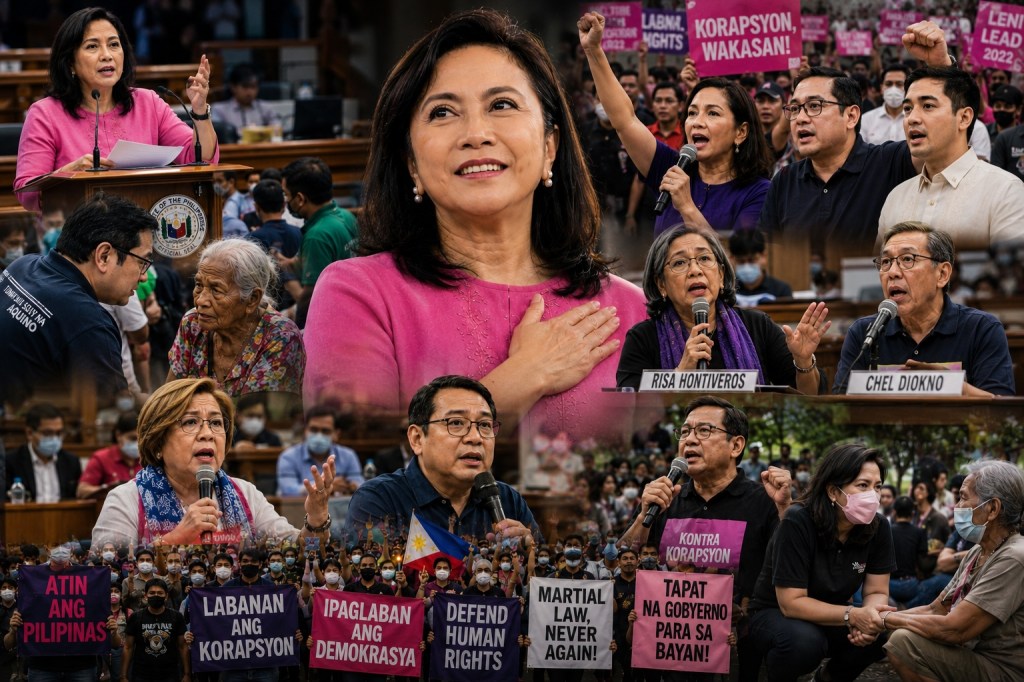
The challenge confronting the opposition is not simply the absence of a charismatic presidential contender, but the absence of a durable political machinery, a sustained organisational ecosystem, and a compelling political-economic vision capable of attracting long-term investment, loyalty, and social constituency-building across classes and regions.

The Marcos restoration did not emerge from historical inevitability, nor from mere nostalgia. It was the outcome of nearly four decades of disciplined political reconstruction following the family’s ouster in 1986. From the moment Ferdinand Marcos fled Malacañang, the Marcoses treated political rehabilitation as a continuous and intergenerational project. They rebuilt provincial bailiwicks in Ilocos, preserved congressional footholds through successive electoral victories, cultivated relationships with entrenched political clans, embedded themselves within shifting elite coalitions, and—perhaps most decisively—invested heavily in a digital and cultural ecosystem that gradually reframed historical memory for a new generation.

The eventual Marcos-Duterte alliance was the culmination of years of patient political consolidation, regional alliance-building, and strategic positioning. The Uniteam formula effectively combined the Marcos machinery in Northern Luzon with Duterte influence in Mindanao, while making significant inroads into the Visayas. It transformed fragmented dynastic influence into a national electoral juggernaut.

The opposition, by contrast, has largely operated through an ad hoc politics of resistance rather than a sustained politics of power-building. Coalitions are repeatedly assembled at the last possible moment, often driven more by immediate electoral necessity than by coherent ideological or programmatic alignment. Signals sent to potential allies are frequently inconsistent: unity is invoked rhetorically while rival candidacies are entertained informally; democratic reform is promised, yet local machinery-building remains weak; broad coalitions are sought, but long-term political integration rarely materialises.

Even where financial support potentially exists—from segments of the business sector, overseas Filipinos, reform-oriented networks, civil society organisations, and progressive constituencies—the opposition often arrives too late to consolidate these resources into a coherent and sustained political infrastructure. By the time national candidacies are formalised, resources, loyalties, and local alliances have frequently already migrated elsewhere.

This is not merely a tactical weakness. It reflects a deeper structural problem in the way opposition politics has evolved in the Philippines. Electoral mobilisation remains heavily candidate-centric and episodic, rather than institutional and continuous. Political engagement intensifies during election cycles, then dissipates afterward. Party-building remains weak, regional expansion inconsistent, and leadership development thin beyond a small circle of nationally recognisable personalities.

The Liberal Party, in particular, has struggled to transform itself into a genuinely national, mass-based political organisation capable of sustained grassroots consolidation outside its traditional areas of strength. It has not invested sufficiently in building second- and third-tier leadership across regions where it remains electorally vulnerable. Nor has it systematically cultivated a new generation of nationally viable political figures capable of carrying a long-term democratic reform agenda beyond the Aquino-Robredo political lineage.

The result is both a leadership vacuum and a broader crisis of political reproduction. At the heart of this weakness is the absence of a compelling and sustained national development agenda capable of functioning as the anchor for long-term political investment and coalition-building. The opposition has often defined itself primarily in relation to what it opposes—corruption, authoritarianism, disinformation, impunity—rather than through a deeply articulated and socially embedded programme for national transformation.

Yet democratic resistance alone is rarely sufficient to sustain long-term political mobilisation, particularly in contexts marked by persistent inequality, regional disparities, elite capture, vulnerability, and deep public frustration over everyday economic insecurity.

What is needed is not the replication of the Marcoses’ motivations. The Marcos political project was fundamentally rooted in dynastic restoration, historical revisionism, and the recovery of state power lost in 1986. The opposition cannot and should not derive its coherence from the same impulse. Its challenge is fundamentally different: to construct a progressive and credible national project capable of linking democracy with material transformation, institutional reform, and social justice.

Such a project must move beyond abstract liberalism and articulate a concrete and integrated political, economic, and social vision for the country.

Politically, this would require a sustained commitment to democratic deepening: institutional accountability, rule of law, protection of civil liberties, press freedom, electoral reform, and accountability for human-rights violations. But these democratic commitments must also be connected to material questions of governance and public welfare.

Economically, the opposition must articulate a development framework that addresses structural inequality rather than merely managing it. This includes progressive taxation, labour protection, industrial and agricultural revitalisation, anti-monopoly regulation, food security, strategic economic sovereignty, and a more equitable distribution of development gains across regions and sectors.

Socially, it requires a serious commitment to universal healthcare, quality public education, social housing, climate resilience, environmental justice, and social protection systems capable of addressing both chronic poverty and emerging vulnerabilities associated with economic instability and climate change. Even national sovereignty issues—such as the defence of the West Philippine Sea—must be situated not only within geopolitical discourse but within broader questions of democratic accountability, resource security, and national dignity.

Without such a programme, opposition politics risks remaining personality-driven and emotionally reactive rather than structurally transformative.

A coherent national agenda matters not only because it clarifies policy direction. It also creates the conditions for long-term political investment. Donors, reform-oriented business sectors, grassroots organisers, civil society actors, youth movements, labour groups, local political leaders, and ordinary citizens are more likely to invest sustained resources and commitment when they see not merely an electoral campaign, but a viable and enduring political project.

The Robredo Paradox

Most Philippine political families enter politics because politics is their family business. Office, influence, and dynastic continuity are part of a single project. Children are prepared for succession. Family identity becomes intertwined with political power. Withdrawal from politics is therefore not a neutral choice but a loss of influence, status, and access. The Robredos do not fit comfortably into that model.

Leni Robredo’s political journey appears inseparable from Jesse Robredo’s legacy of public service. Yet that same legacy was never about building a dynasty. It was about governance, reform, and service. The result is a curious tension. The family carries a moral and political legacy that many supporters feel should continue to find expression in public leadership, but they do not appear to possess the dynastic instinct that typically drives political families to perpetuate themselves in power. That tension may explain much about the current moment.

In many ways, the Robredos embody two competing impulses. On one hand is the imperative of continuing a public-service tradition that began with Jesse Robredo and that many Filipinos now associate with integrity, competence, and democratic governance. On the other hand is an equally understandable desire to live meaningful, productive, and fulfilling lives beyond politics. The family has already paid a steep price in service to the nation. Jesse Robredo’s death while serving in government is a constant reminder that public office carries costs that extend far beyond elections and political attacks.

Unlike political dynasties that seek to preserve power across generations, the Robredos seem uniquely positioned to walk away from politics altogether. Their daughters have established their own academic and professional identities. They are strongly positioned for public service, but none appears to have been groomed for political succession. Their family’s future does not depend on retaining public office. Yet it is precisely because they are not a dynasty that many Filipinos continue to see them as an authentic alternative to dynastic politics.

This is the paradox of the Robredos. The very qualities that make them attractive to many reform-minded Filipinos and deserving of leadership position—their apparent lack of dynastic ambition, their rootedness outside politics, and their ability to lead lives independent of public office—are also the qualities that make it difficult to assume they will remain in politics indefinitely.

For the opposition, this paradox carries an uncomfortable lesson. If the future of democratic reform depends heavily on a family that has repeatedly demonstrated its willingness to leave politics behind, then the problem is not the family. The problem is the opposition’s failure to develop institutions, leaders, and movements capable of carrying that legacy forward without relying on the continued sacrifice of the Robredos themselves.

When Robredo finally committed to the 2022 presidential race, she inspired one of the most remarkable volunteer-driven mobilisations in contemporary Philippine political history. The pink movement demonstrated extraordinary levels of grassroots energy, civic participation, youth engagement, and decentralised volunteerism across the country. That mobilisation was not the product of organisational coercion or dynastic machinery. It reflected genuine public yearning for an alternative political future.

Yet the movement also exposed the limits of charisma and moral legitimacy in the absence of equivalent long-term organisational infrastructure. Enthusiasm alone could not compensate for decades of machine-building, alliance consolidation, narrative warfare, and political financing accumulated by rival political forces.

In this sense, Robredo’s reluctance is politically significant not because it proves unsuitability for leadership, but because it reflects a broader tension within reform-oriented politics itself: the persistent underestimation of the extent to which democratic politics also requires continuous power-building, strategic endurance, and organisational consolidation.

From a purely strategic opposition standpoint, her decision not to contest the presidency in 2028—despite surveys indicating a potentially competitive race and despite the absence of another opposition figure with comparable national recall, legitimacy, and mobilising capacity—inevitably deepens the leadership vacuum confronting the democratic opposition. Senator Kiko Pangilinan’s concerns about this vacuum are therefore not exaggerated. They reflect a structural reality.

But the responsibility for that vacuum cannot be placed on Robredo alone. She is also a product of a broader opposition ecosystem that has repeatedly failed to institutionalise its gains, consolidate its movements, and sustain political engagement beyond electoral moments. The opposition has not built the organisational, financial, ideological, and territorial infrastructure required for a long political struggle. Nor has it fully internalised the hard lesson that the Marcoses understood decades ago: political power is not won only during campaigns; it is accumulated continuously through organisation, narrative construction, alliance maintenance, constituency-building, and institutional endurance.

The central issue, therefore, is not whether Robredo is “fit” for the presidency. The deeper question is whether the opposition is finally prepared to treat politics as a permanent vocation rather than an episodic reaction to democratic crisis.

The Marcoses succeeded not only because they worked harder—though in many respects they did—but because they approached politics as a generational project requiring patience, discipline, strategic flexibility, and relentless investment in political infrastructure.

The opposition continues, too often, to approach politics as a recurring emergency to be managed periodically.

Until this changes, electoral cycles will continue to expose the same structural weaknesses: fragmented coalitions, inconsistent messaging, weak regional machinery, shallow leadership benches, underdeveloped political institutions, and the absence of a unifying national programme capable of binding together diverse democratic constituencies over the long term.

The challenge confronting the opposition today is therefore far larger than the candidacy of any single individual. It is the challenge of constructing a credible, progressive, and deeply rooted national development project that Filipinos can believe in, invest in, and sustain politically over decades rather than electoral seasons.

Without such a transformation, reluctance will continue to appear as the central problem when, in reality, it is merely one manifestation of a much deeper crisis: the opposition’s continuing failure to prepare systematically, organise continuously, articulate a transformative vision, and remain embedded in the long game of democratic politics.

The stakes extend far beyond electoral victory. They concern the future character of Philippine democracy itself.
The Unfinished Republic

My reflections on EDSA

First Instalment

On the occasion of the fortieth anniversary of EDSA People Power, I find myself uneasy with how carelessly we talk about it. The arguments have hardened into familiar scripts. One point of view treats EDSA as sacred ground — a completed moral triumph beyond criticism. The other dismisses it as an elite maneuver that hijacked a revolution and therefore deserves nothing but scorn. Both positions, in their own ways, avoid something more uncomfortable: accountability.

There is yet another view, one that has gained traction in recent years. It argues that the promises of EDSA were betrayed by those who led it — perhaps the liberal democrats — who, according to critics and political opponents, have ruled the country ever since. This misinformed view characterises the last four decades as a single, uninterrupted liberal order, and everything that went wrong can be laid at its feet.

It is an attractive argument because it is simple. It compresses forty complicated years into one ideological villain. 

But it is not historically accurate.

Corazon Aquino presided over six transitional and deeply unstable years mostly under a revolutionary government. Fidel Ramos followed with a technocratic modernization program shaped as much by global market currents as by neoliberal philosophy. Joseph Estrada’s presidency was explicitly populist and rhetorically anti-elite. Gloria Macapagal Arroyo presided over fiscal consolidation and political survival for more than nine years. Benigno Aquino III governed for six reformist years focused on anti-corruption and institutional discipline. Rodrigo Duterte then steered the country toward an openly illiberal and authoritarian territory. And now Ferdinand Marcos Jr. leads under yet another political alignment, as if completing a political circle – one step up, two steps back.

To say that “liberals ruled for forty years” erases the shifts, contradictions, and power realignments that defined the post-EDSA republic, and flattens all this and the current authoritarian drift into one convenient label. It also obscures the more persistent truth: political dynasties, oligarchic families, and patronage networks have adapted fluidly across administrations, regardless of political allegiances.

This does not absolve liberal democrats of responsibility. Some reforms stalled. Some opportunities were missed. Structural inequality was not acknowledged and dismantled. But responsibility must be distributed honestly. Myth-making may mobilise resentment, but it does not clarify history.

I was part of the generation shaped by that period. Many of us believed – sincerely – that we were standing at the threshold of a different republic. Not perfect, not revolutionary in the romantic sense, but open. A republic where institutions could be rebuilt, where the social justice provisions of the new Constitution could slowly reshape the political economy, where democratic space could be used for deeper transformation.

EDSA was not a finish line. It was not a betrayal either. It was both a milestone and a beginning. Perhaps it was a squandered opportunity or an unfinished business.

What followed was not preordained by those four days in February. It was shaped by choices – alliances made and broken, movements that fragmented, elites who adapted instead of retreating, reformists who sometimes mistook macroeconomic stability for structural change, and citizens who, over time, grew tired of waiting for justice that seemed permanently deferred.

We also need to be honest about the context. The Marcos dictatorship did not fall because people gathered at a highway alone. By the mid-1980s, the country was in severe economic crisis. Output had collapsed in 1984 and 1985. Debt had ballooned. Legitimacy had eroded. The regime was weakened economically, morally, and institutionally. The uprising was the culmination of multiple, layered pressure – years of organizing, resistance, repression, fracture, and contested legitimacy. It was not a miracle detached from material reality.

What EDSA decisively restored was civic space. Elections meant something again. Newspapers reopened. Political prisoners were freed. A new Constitution was drafted with safeguards against the concentration of power. These were not small achievements.

But restoration is not transformation.

Liberal democracy is indispensable for preventing dictatorship. I will never argue otherwise. Yet liberal democracy, by itself, does not dismantle oligarchy. It does not automatically redistribute land. It does not prevent political dynasties from reconstituting themselves within electoral politics. It does not dissolve wealth concentration. In societies like ours — where inequality is historically embedded – procedural democracy can coexist with structural injustice.

When that coexistence persists for decades, legitimacy becomes fragile, not because people want another dictator, but because they grow tired of reforms that are either stalled or never seem to reach the roots of inequality. Fatigue becomes fertile ground for strongman narratives and resentment becomes political currency.

The restoration of liberal democracy in 1986 was necessary. It was immeasurably better than authoritarian rule. But it proved insufficient – under Philippine structural conditions – to produce a durable settlement of social justice. 

We overthrow, we restore, we stabilize. Then we drift. EDSA became a symbol, sometimes more than a program. Those who benefited from democratic reopening often retreated from the harder work of institutional transformation. Meanwhile, democratic forces fractured – liberals defending procedure but constrained by elite capture; progressives demanding transformation but divided by doctrine, suspicion, and tactical missteps. Over time, these differences became perennial debates, then turned into identities. We learned to distrust each other more than we learned to build together.

And so the Marcos-Duterte axis did not rise from deception alone. It fed on real disillusionment. It fed on inequality that remained acute despite stability and growth. It fed on opposition movements that could not sustain unified moral direction. It fed on our own inability to convert democratic space into structural change.

There is also a geopolitical layer that complicates everything. The global shift toward neoliberal policy in the 1980s, the end of the Cold War, the rise of export-led East Asian growth, and the emergence of China as a strategic power all reshaped the terrain on which our democracy operated. China’s growing assertiveness in the South China Sea – and its rejection of the 2016 arbitral ruling – remind us that sovereignty and democracy today are contested not only internally but externally. Fragmented domestic politics makes meddling and manipulation by external forces easier.

So when we mark forty years since EDSA, the task is not commemoration for its own sake. It is reflection. It is asking whether we treated 1986 as an end point rather than the beginning of a generational reconstruction.

If EDSA is to remain historically meaningful, it must be reclaimed as unfinished – an incomplete republic-building project that still demands deeper institutional shifts toward something more socially democratic, more just, and more transformative.

Next:

What follows is not a morality play. It is a historical reckoning. We will revisit the fractures of the 1980s, examine administrations past the caricatures, confront the mathematics of reality, and ask whether liberal democracy — as practiced in an oligarchic society — is enough.

It may not be.

And if it is not, then the responsibility is no longer about defending or denouncing EDSA. It is about completing it.

Beyond Borders, Beyond “Normal”

Solidarity, Democracy, and the Transformative Future We Must Build

My previous posts explored the lessons of COVID-19, the urgent need for flood-proof cities, the links between health and climate, the failures of car-centric mobility, and the fragility of education. Each theme pointed to the same conclusion: the systems we inherited were unjust, unsustainable, fragile, and corruptible. Business-as-usual is not only broken; it is dangerous.

But to reimagine life, society, and governance, we must go beyond national reforms. Climate change, pandemics, disinformation, and corruption spill across borders. The future of transformative change depends on solidarity — global, regional, and local — and on leadership that strengthens democracy, not dismantles it.

Hybrid Futures

The pandemic revealed both possibility and fragility. Hybrid work showed that productivity need not mean traffic and smog; hybrid study proved that learning can adapt to crisis. But millions without savings, digital access, or social protection were left behind. In the Philippines, people had no choice but to break lockdowns to survive, leading to devastating infection waves. The lesson is not that lockdowns failed, but that governance failed to protect the poor.

Hybrid futures must be made a right — supported by investments in community hubs, digital access, and social safety nets. To treat them as privileges is to deepen inequality. To secure them as rights is to build a transformative society where adaptation is equitable and inclusive.

Transformative Systems

Year after year, floods devastate lives and livelihoods. The Philippines loses ₱133 billion annually to flood damages (World Bank, 2022), while extreme heat increasingly shuts down schools and workplaces. Yet from 2022 to 2024, ₱545 billion was poured into flood control projects riddled with corruption. Infrastructure built as political pork cannot protect people.

Transformative adaptation demands accountable governance: transparent budgets, participatory planning, and leadership willing to legislate for long-term safety rather than short-term patronage.

People-Centered Mobility

Metro Manila bleeds ₱3.5 billion daily in congestion costs. A statistical modelling by the Centre for Research on Energy and Clean Air (CREA) in 2023 using air pollution, rates of exposure, and health coefficients, estimated that air pollution killed 66,000 Filipinos in 2019 (WHO). Cars, less than 30 percent of trips, still dominate over 70 percent of road space (MMDA). This is not accidental. It is the product of choices — choices to prioritize projects ripe for kickbacks while delaying public transport modernization.

Mobility reform is not only about buses, trains, and bike lanes. It is about justice: pregnant women, elderly citizens, children, and persons with disabilities deserve safe, dignified mobility. Hybrid work and study can ease pressure, but governance must shift resources from car-centric “development” to a transformative vision of mobility that puts people and dignity first.

Community Hubs

Education disruptions are mounting: 32 lost teaching days in 2023–2024 due to floods and heat, 19 million students affected by Storm Trami, and more than 4,000 damaged schools in three years. When disaster strikes, learning collapses.

Community hubs — with internet, childcare, and safe study spaces — can keep education alive. But this requires governance that prioritizes equity, not just elite schools. It also requires digital infrastructure that is secure from sabotage and espionage, ensuring transformative adaptation in education, where learning continues despite shocks and inequalities are reduced rather than widened.

Accountable Leadership

Across every sector, corruption bleeds resources away from transformation. Citizens are taxed, then asked to shoulder modernization costs, while contractors and officials profit. This is not leadership; it is betrayal.

True leadership does not mean authoritarian shortcuts. We should have learned this from both past dictatorships and current populist regimes that suppress dissent while enabling graft. Authoritarianism promises efficiency but delivers corruption, fear, and weakened institutions. What we need are leaders who defend democracy and the rule of law — locally and globally — while reforming systems to serve the public good.

Good governance is not abstract. It is the decisive factor that makes hybrid work equitable, flood defenses real, transport safe, and education transformative and future-ready.

Global and Regional Solidarity

The Philippines cannot face these challenges alone. Corruption, climate shocks, and pandemics spill across borders. Around the world, citizens have risen in protests against corruption and inequality, signaling a shared demand for accountability. Yet at the same time, we see backsliding: climate denial, ultranationalism, immigration scapegoating, unjust trading practices, and a slide toward despotic rule.

What is needed is solidarity. A peace premium: shifting resources away from militarism and corruption toward schools, health, transformative adaptation, and digital equity. Global institutions like the Pact for the Future and the Global Digital Compact hint at this direction but must be made more accountable to citizens rather than power blocs.

ASEAN, too, must step up. It can no longer afford to be a cautious talk shop. As a bloc, it can amplify the voices of its less developed members — Cambodia, Laos, Myanmar, and the Philippines — in demanding fairer climate finance, human-centered digital governance, and international rules that protect people, not only markets. A stronger ASEAN voice on global platforms is essential for justice in the region.

The Courage to Imagine

The greatest danger is not only corruption or climate collapse but nostalgia — the longing to “return to normal,” as if that normal were ever just. The air we breathed before the pandemic was thick with smog from jeepneys and cars; the streets of Metro Manila were clogged daily with traffic that drained ₱3.5 billion in wasted time and fuel. The schools were already overstretched, with leaking roofs and overcrowded classrooms. Hospitals were underfunded, forcing poor families to pay out of pocket or go untreated. Governance was corrupted by budget insertions and ghost projects. That past was not safe, equal, or sustainable. To cling to it is to chain ourselves to crises that will only intensify.

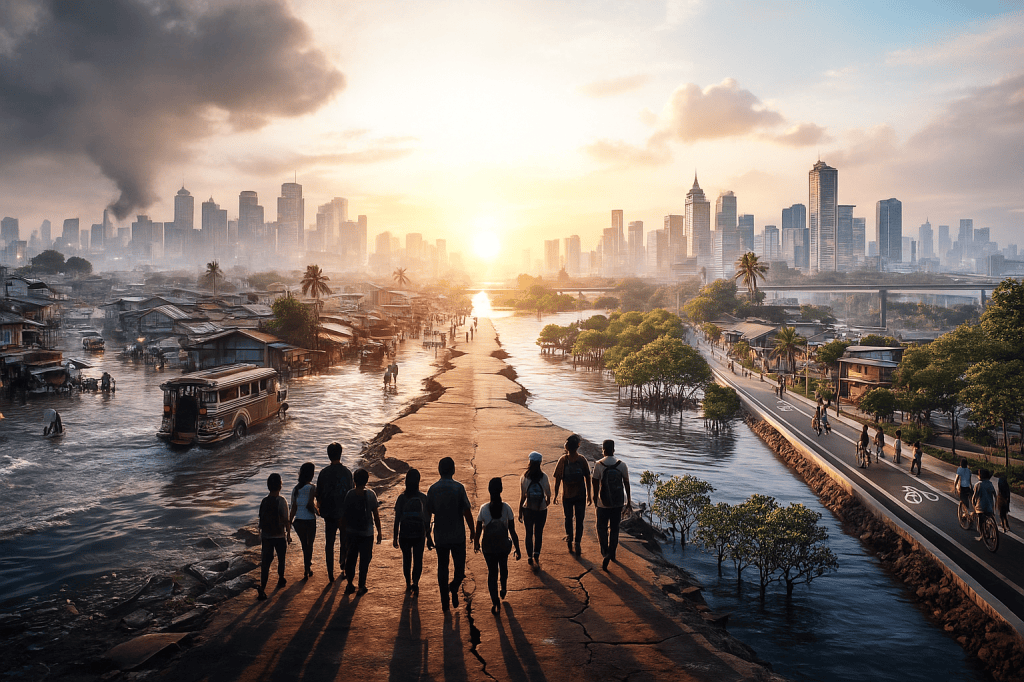
What we need instead is courage to imagine a transformative future, rooted in our own realities. Imagine barangay hubs where parents type reports while children learn nearby, both sheltered from floods or extreme heat. Imagine jeepneys reborn as clean electric shuttles, safe for children and elderly passengers, no longer symbols of survival but of dignity. Imagine mangrove parks along Manila Bay that serve as flood barriers by day and recreation spaces by evening, proof that nature and city life can co-exist. Imagine hospitals equipped with solar power, mobile clinics reaching far-flung barangays, and health workers supported, not abandoned, by government.

Picture classrooms that no storm can silence, because every child has access to safe, connected learning spaces. Picture governance where every peso is traceable, every contract open to citizen oversight, and leaders earn respect not through fear but through trust. Picture businesses competing to design the most transformative homes, the safest transport, and the most affordable internet, proving that profit and public good can reinforce one another.

And picture borders not as walls of fear, but as bridges of cooperation — an ASEAN that secures climate finance, fair trade, and digital justice for its peoples, and a global community that prizes peace as the best investment in human survival.

These are not dreams too lofty for the Philippines. They are already glimpsed in Marikina’s flood monitoring, Iloilo’s river rehabilitation, Cebu’s rainwater harvesting, BGC’s cisterns, and Naga’s participatory planning. What is missing is not capacity or resources, but imagination — and the governance to make imagination real.

Toward a Just and Transformative Future

The crises we face — floods, pandemics, authoritarian backsliding — are products of human choices. And because they are human-made, they can be unmade. The question is whether we will have the courage to choose differently.

Citizens must demand accountability. Businesses must innovate for transformation rather than collude for profit. Leaders must strengthen, not weaken, democracy and the rule of law. ASEAN must amplify vulnerable voices. Global institutions must reorient toward human security.

The choice is stark: continue shackled to nostalgia for a broken past, or free ourselves to build a just and transformative future that redefines how we live, work, learn, and govern.

The imagination premium is within reach — if we demand it, defend it, and act on it together.