Beyond Borders, Beyond “Normal”

Solidarity, Democracy, and the Transformative Future We Must Build

My previous posts explored the lessons of COVID-19, the urgent need for flood-proof cities, the links between health and climate, the failures of car-centric mobility, and the fragility of education. Each theme pointed to the same conclusion: the systems we inherited were unjust, unsustainable, fragile, and corruptible. Business-as-usual is not only broken; it is dangerous.

But to reimagine life, society, and governance, we must go beyond national reforms. Climate change, pandemics, disinformation, and corruption spill across borders. The future of transformative change depends on solidarity — global, regional, and local — and on leadership that strengthens democracy, not dismantles it.

Hybrid Futures

The pandemic revealed both possibility and fragility. Hybrid work showed that productivity need not mean traffic and smog; hybrid study proved that learning can adapt to crisis. But millions without savings, digital access, or social protection were left behind. In the Philippines, people had no choice but to break lockdowns to survive, leading to devastating infection waves. The lesson is not that lockdowns failed, but that governance failed to protect the poor.

Hybrid futures must be made a right — supported by investments in community hubs, digital access, and social safety nets. To treat them as privileges is to deepen inequality. To secure them as rights is to build a transformative society where adaptation is equitable and inclusive.

Transformative Systems

Year after year, floods devastate lives and livelihoods. The Philippines loses ₱133 billion annually to flood damages (World Bank, 2022), while extreme heat increasingly shuts down schools and workplaces. Yet from 2022 to 2024, ₱545 billion was poured into flood control projects riddled with corruption. Infrastructure built as political pork cannot protect people.

Transformative adaptation demands accountable governance: transparent budgets, participatory planning, and leadership willing to legislate for long-term safety rather than short-term patronage.

People-Centered Mobility

Metro Manila bleeds ₱3.5 billion daily in congestion costs. A statistical modelling by the Centre for Research on Energy and Clean Air (CREA) in 2023 using air pollution, rates of exposure, and health coefficients, estimated that air pollution killed 66,000 Filipinos in 2019 (WHO). Cars, less than 30 percent of trips, still dominate over 70 percent of road space (MMDA). This is not accidental. It is the product of choices — choices to prioritize projects ripe for kickbacks while delaying public transport modernization.

Mobility reform is not only about buses, trains, and bike lanes. It is about justice: pregnant women, elderly citizens, children, and persons with disabilities deserve safe, dignified mobility. Hybrid work and study can ease pressure, but governance must shift resources from car-centric “development” to a transformative vision of mobility that puts people and dignity first.

Community Hubs

Education disruptions are mounting: 32 lost teaching days in 2023–2024 due to floods and heat, 19 million students affected by Storm Trami, and more than 4,000 damaged schools in three years. When disaster strikes, learning collapses.

Community hubs — with internet, childcare, and safe study spaces — can keep education alive. But this requires governance that prioritizes equity, not just elite schools. It also requires digital infrastructure that is secure from sabotage and espionage, ensuring transformative adaptation in education, where learning continues despite shocks and inequalities are reduced rather than widened.

Accountable Leadership

Across every sector, corruption bleeds resources away from transformation. Citizens are taxed, then asked to shoulder modernization costs, while contractors and officials profit. This is not leadership; it is betrayal.

True leadership does not mean authoritarian shortcuts. We should have learned this from both past dictatorships and current populist regimes that suppress dissent while enabling graft. Authoritarianism promises efficiency but delivers corruption, fear, and weakened institutions. What we need are leaders who defend democracy and the rule of law — locally and globally — while reforming systems to serve the public good.

Good governance is not abstract. It is the decisive factor that makes hybrid work equitable, flood defenses real, transport safe, and education transformative and future-ready.

Global and Regional Solidarity

The Philippines cannot face these challenges alone. Corruption, climate shocks, and pandemics spill across borders. Around the world, citizens have risen in protests against corruption and inequality, signaling a shared demand for accountability. Yet at the same time, we see backsliding: climate denial, ultranationalism, immigration scapegoating, unjust trading practices, and a slide toward despotic rule.

What is needed is solidarity. A peace premium: shifting resources away from militarism and corruption toward schools, health, transformative adaptation, and digital equity. Global institutions like the Pact for the Future and the Global Digital Compact hint at this direction but must be made more accountable to citizens rather than power blocs.

ASEAN, too, must step up. It can no longer afford to be a cautious talk shop. As a bloc, it can amplify the voices of its less developed members — Cambodia, Laos, Myanmar, and the Philippines — in demanding fairer climate finance, human-centered digital governance, and international rules that protect people, not only markets. A stronger ASEAN voice on global platforms is essential for justice in the region.

The Courage to Imagine

The greatest danger is not only corruption or climate collapse but nostalgia — the longing to “return to normal,” as if that normal were ever just. The air we breathed before the pandemic was thick with smog from jeepneys and cars; the streets of Metro Manila were clogged daily with traffic that drained ₱3.5 billion in wasted time and fuel. The schools were already overstretched, with leaking roofs and overcrowded classrooms. Hospitals were underfunded, forcing poor families to pay out of pocket or go untreated. Governance was corrupted by budget insertions and ghost projects. That past was not safe, equal, or sustainable. To cling to it is to chain ourselves to crises that will only intensify.

What we need instead is courage to imagine a transformative future, rooted in our own realities. Imagine barangay hubs where parents type reports while children learn nearby, both sheltered from floods or extreme heat. Imagine jeepneys reborn as clean electric shuttles, safe for children and elderly passengers, no longer symbols of survival but of dignity. Imagine mangrove parks along Manila Bay that serve as flood barriers by day and recreation spaces by evening, proof that nature and city life can co-exist. Imagine hospitals equipped with solar power, mobile clinics reaching far-flung barangays, and health workers supported, not abandoned, by government.

Picture classrooms that no storm can silence, because every child has access to safe, connected learning spaces. Picture governance where every peso is traceable, every contract open to citizen oversight, and leaders earn respect not through fear but through trust. Picture businesses competing to design the most transformative homes, the safest transport, and the most affordable internet, proving that profit and public good can reinforce one another.

And picture borders not as walls of fear, but as bridges of cooperation — an ASEAN that secures climate finance, fair trade, and digital justice for its peoples, and a global community that prizes peace as the best investment in human survival.

These are not dreams too lofty for the Philippines. They are already glimpsed in Marikina’s flood monitoring, Iloilo’s river rehabilitation, Cebu’s rainwater harvesting, BGC’s cisterns, and Naga’s participatory planning. What is missing is not capacity or resources, but imagination — and the governance to make imagination real.

Toward a Just and Transformative Future

The crises we face — floods, pandemics, authoritarian backsliding — are products of human choices. And because they are human-made, they can be unmade. The question is whether we will have the courage to choose differently.

Citizens must demand accountability. Businesses must innovate for transformation rather than collude for profit. Leaders must strengthen, not weaken, democracy and the rule of law. ASEAN must amplify vulnerable voices. Global institutions must reorient toward human security.
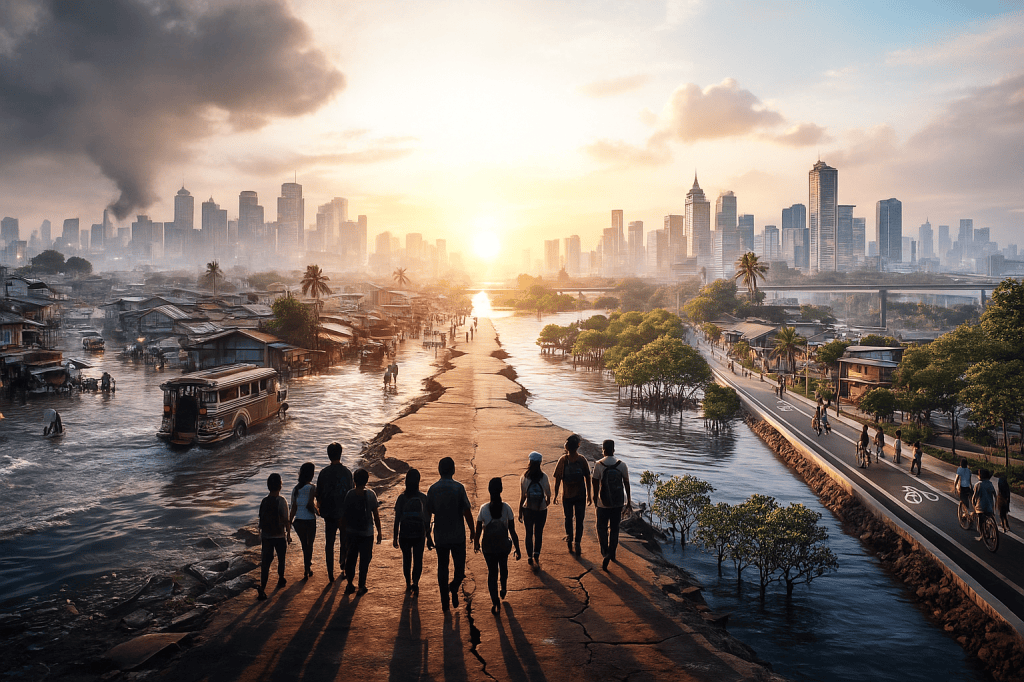
The choice is stark: continue shackled to nostalgia for a broken past, or free ourselves to build a just and transformative future that redefines how we live, work, learn, and govern.

The imagination premium is within reach — if we demand it, defend it, and act on it together.
Building Resilience Beyond Sandbags and Scandals

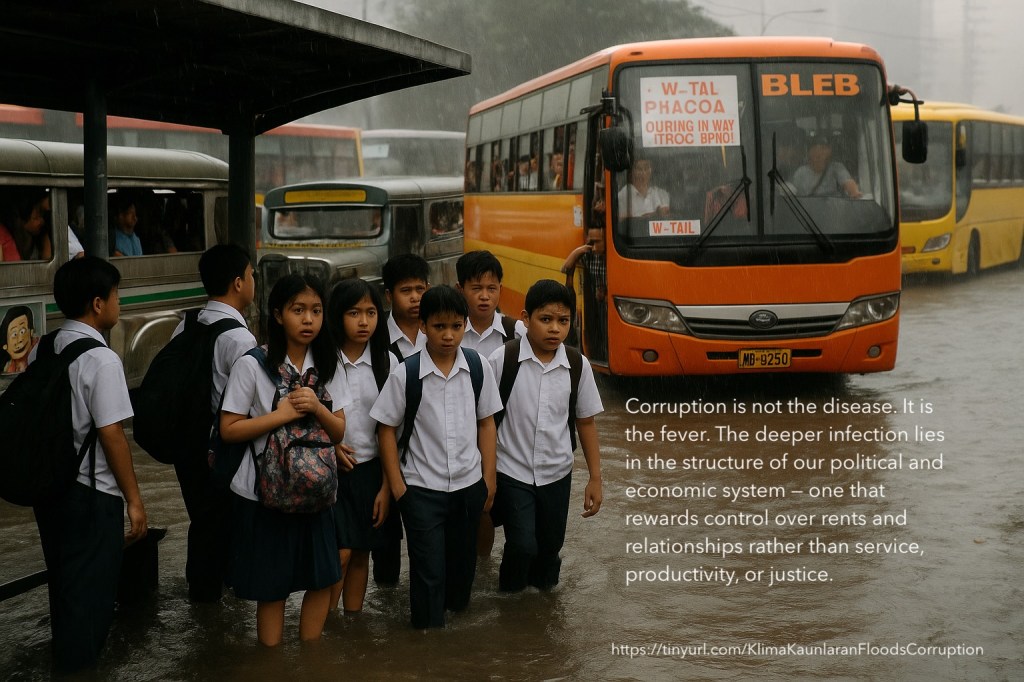
Every rainy season, Filipinos brace themselves for the same ordeal: flooded streets, stranded commuters, classrooms turned into evacuation centers, and homes filled knee-deep with murky water. According to the World Bank, more than 14 million Filipinos are exposed to flooding each year, with damages averaging ₱133 billion (≈US$2.4 billion) annually in lost assets, livelihoods, and productivity (World Bank, 2022).

Climate change is already magnifying this threat. PAGASA projects that extreme daily rainfall events will become more frequent, particularly in Luzon and the Visayas. At the same time, sea levels around the Philippines are rising at nearly double the global average — between 5.7 and 7.0 millimeters per year — making coastal flooding more frequent and destructive (World Meteorological Organization, 2023; PAGASA). Combined with rapid urbanization, clogged drainage systems, and the spread of informal settlements into floodplains, the current normal of yearly floods will only worsen unless the country embraces systemic change.

Citizenship and Culture: Demanding Change

For decades, citizens have been expected to “cope” with floods by stacking sandbags, raising furniture, or wading through waist-deep water. These coping mechanisms, repeated year after year, normalize disaster and shift responsibility to households that are often the least equipped to manage it. Resilience, however, must go beyond individual sacrifice.

True citizenship in the face of flooding means demanding transparency in how flood control budgets are spent. Billions of pesos are inserted into the General Appropriations Act every year for flood control projects, yet many are poorly built or never completed at all, as the Commission on Audit has repeatedly flagged. Civic groups, barangay councils, and homeowners’ associations can serve as watchdogs, pushing back against the entrenched culture of “budget insertions” that fuels corruption. At the same time, culture itself matters: reducing household waste that clogs drainage, participating in greening efforts, and embracing resilience as a shared responsibility all help ensure that solutions are not purely technical, but also social and cultural.

Floods are not inevitable acts of fate. They are failures of planning, governance, and accountability. Citizens have both the power and responsibility to demand more.

Governance: Protection

The governance failures in flood management are glaring. Between 2022 and 2024 alone, the government allocated ₱545 billion for flood control projects, yet many of these projects were later flagged as substandard, overpriced, or even non-existent (Reuters, 2025). Each year, the National Expenditure Program is transformed into the General Appropriations Act through budgetary “insertions” that inflate flood control allocations well beyond technical needs. Instead of protecting citizens, these projects too often become conduits for political patronage and private gain.

Shifting from pork to protection requires a new governance framework. Legislation must establish climate-resilient infrastructure standards, mandating underground floodwater reservoirs, expanded drainage networks, permeable pavements, and the integration of green infrastructure in all new developments. Urban planning must adopt a landscape approach that respects natural waterways, wetlands, and river basins, rather than building over them. Independent oversight bodies such as the Commission on Audit and the Ombudsman must be empowered to prosecute ghost projects and penalize both officials and contractors engaged in corruption. Finally, relocation and housing strategies must prioritize the poor, ensuring that informal settlers are not simply evicted from flood-prone areas but offered dignified, safe alternatives.

Without accountability and foresight, even the most sophisticated engineering projects will fail. Flood control must no longer be treated as a political prize but as a public necessity.

Private Sector: Innovation

The private sector occupies a complicated space in the story of floods. On the one hand, construction firms and contractors have too often been complicit in overpricing, license-renting, and ghost projects, benefiting from the very corruption that undermines public resilience. On the other, businesses also possess the expertise, technology, and resources that could drive innovative solutions.

For the private sector to shift from collusion to innovation, it must refuse participation in corrupt bidding schemes and commit to integrity in procurement. Developers can incorporate flood-resilient designs, including underground cisterns, elevated foundations, and permeable surfaces that reduce runoff. Partnerships with government could expand drainage systems, establish rainwater harvesting schemes, and invest in wastewater reuse, turning floodwater from a hazard into a resource. More fundamentally, businesses must see resilience not as a burden but as a market opportunity. Companies that lead in climate-resilient infrastructure will not only protect communities but also open new domestic and international markets. The cycle must change: from profits alone, to public good, and back again to market growth.

Learning from Models Abroad

The Philippines does not need to invent solutions from scratch. Other countries have faced similar threats and built models worth adapting. In Tokyo, the Metropolitan Area Outer Underground Discharge Channel is a vast system of tunnels and tanks that capture excess floodwater during storms. While prohibitively expensive at full scale, smaller underground cisterns beneath parks or intersections could be piloted in Manila or Cebu. In Singapore, the Marina Barrage functions as both a tidal barrier and a freshwater reservoir, while also serving as public space — a model of how infrastructure can combine resilience with livability. The Netherlands’ “Room for the River” program restores floodplains and wetlands, proving that giving rivers more space can sometimes be more effective than raising dikes. Bangkok’s “Monkey Cheek” reservoirs, where urban parks double as floodwater retention basins, offer a low-cost solution particularly relevant for dense Asian cities.

Philippine Pilots: Proof It’s Possible

Encouragingly, there are also homegrown examples that show resilience is possible when governance and citizen action align. Marikina City has developed a community-based flood warning system that provides real-time alerts, saving lives during typhoons. Iloilo has rehabilitated its river through mangrove replanting, clean-ups, and strict zoning enforcement, transforming a once-polluted waterway into a model of flood mitigation and urban renewal. Cebu has piloted rainwater harvesting systems in schools and barangays, demonstrating how small-scale innovations can reduce both flooding and water scarcity. Naga City has integrated participatory governance into its disaster planning, ensuring that citizens themselves are partners in shaping resilience strategies.

These local cases prove that innovation and accountability can make a tangible difference. The challenge lies in scaling them up and protecting them from the corruption that undermines so many other efforts.

Toward Flood-Proof Cities

Floods will never disappear entirely in a tropical archipelago like the Philippines. But the devastation we experience today is not inevitable. It is the result of political choices — to treat flood control as pork, to build on natural waterways, to neglect drainage, and to collude rather than innovate.

The path forward is equally a matter of choice. Citizens must refuse to normalize disaster and instead demand transparency. Governance must redirect flood control spending from patronage to protection. The private sector must move beyond collusion and embrace innovation as both duty and opportunity. And the Philippines must draw lessons not only from Tokyo, Singapore, the Netherlands, and Bangkok, but also from its own successes in Marikina, Iloilo, Cebu, and Naga.

Adapted, scaled, and protected from corruption, these models can move the country beyond sandbags and scandals — toward cities that protect lives, livelihoods, and dignity in the face of a changing climate.

Imagining a Post-COVID World – looking and moving forward

The COVID-19 pandemic brought the world to a standstill. Streets fell silent, workplaces closed their doors, schools went online, and families were confined to their homes. For many in the Philippines, these disruptions were particularly harsh. Lockdowns were extended for months, yet instead of controlling infections, they revealed the cracks in governance, the fragility of our systems, and the limits of resilience for millions of ordinary citizens. People needed to work to survive, but most had neither savings nor recourse to safety nets. Daily wage earners were forced to go out in search of income, fueling the continued spread of the virus. Despite enduring one of the world’s longest lockdowns, the country suffered large-scale losses in human life, while corruption in government procurement — from overpriced medical supplies to questionable contracts — undermined public trust when it was needed most.

Yet the pandemic was not only a story of loss. It also forced societies to reimagine how life, work, and community could function differently. The sudden shift to remote work showed that many jobs can be done from home without sacrificing productivity. People discovered they could save fuel, reduce commuting time, and spend more hours with family. For cities notorious for traffic congestion and pollution, hybrid work arrangements offered a glimpse of a future with fewer cars on the road and cleaner air. What was once a privilege of the few should now be recognized as a necessity, an innovation, and even a right — not only to protect health in times of crisis but to reduce the stress, costs, and hazards of unsustainable daily commuting.

Remote learning carried similar lessons. Though uneven and difficult for many, it demonstrated that parents could be more involved in their children’s education and that schools could reimagine how to balance classroom instruction with digital tools. In communities where flooding, heat, or transport makes attending school a daily ordeal, flexible learning arrangements could relieve both financial and health burdens. At the same time, the pandemic underscored that learning from home can only succeed if it is supported by reliable and accessible internet connectivity, safe community hubs, and policies that bridge the gap between rich and poor.

The crisis also reshaped attitudes toward health and hygiene. Handwashing, sanitation, and fitness became more widely recognized as essential to resilience. People began to think more carefully about diet, exercise, mental well-being, and the fragility of their own health. But the pandemic also revealed a cruel divide: those with space at home could exercise, work remotely, shelter safely, and even tend to their home gardens, while millions in cramped housing or informal settlements could not. Resilience, in this sense, was as much about poverty and inequality as it was about public health.

These lessons extend beyond individual households to the broader systems that sustain life. Food production and essential services must continue during crises, but workers in these sectors were often the least resilient and protected. Forests and ecosystems, when preserved, act as natural buffers against zoonotic diseases; when destroyed, they release new risks into human communities. The pandemic reminded us that human health cannot be separated from the health of ecosystems. Preserving habitats and limiting the displacement of animals and viruses are not environmental luxuries — they are public health necessities.

Underlying all of this is the recognition that change cannot be left to individuals alone. A cultural shift in lifestyles and consumption is vital, but without legislation and accountable governance to support it, the system defaults back to old patterns. The pandemic era was rife with corruption, not only in health supplies but also in infrastructure spending, including flood control projects where billions were allocated but many outputs were substandard, overpriced, or simply non-existent. These scandals illustrate the depth of collusion among private contractors, politicians, andgovernment agencies, with citizens too often passive in demanding accountability. If nothing changes, the same patterns of waste and patronage will cripple the country’s ability to cope with future crises.

The private sector also bears responsibility. During the pandemic, some companies protected workers through flexible arrangements, safe facilities, and digital support. Others lobbied for quick reopening regardless of risks or used the crisis as an excuse for retrenchments. As the country reimagines its future, businesses must shift from a narrow focus on profit toward a recognition that their long-term growth depends on secure working conditions and the common good. This means investing in hybrid work infrastructure, ensuring safe working conditions during extreme heat and floods, and refusing collusion in corruption that drains public funds away from essential services. From profit to common good, and back again to market growth — this is the logic that must replace the destructive cycle of greed and short-term, unfair advantages.

The pandemic was a global tragedy, but it was also a rehearsal for the crises that climate change is now making permanent. Extreme heat, unseasonal floods, and stronger storms are the “current normal.” To cope, the Philippines must build systems that prioritise resilience, equity, and accountability. Citizens must adopt new cultural habits that value health, sustainability, and solidarity (e.g., damayan or bayanihan) – a sense of safe community. Governance must be strengthened through legislation that protects the public good and through institutions that resist corruption. The private sector must innovate not just for profit but for the survival and dignity of people.

Imagining a post-COVID world is not about going back to how things were. It is about taking the painful lessons of the pandemic and using them to reorganize how we live, work, learn, and play — with implications that reach across social, economic, political, and ecological systems. Only then can we hope to cope better with the crises ahead and begin the long work of rehabilitating the systems — including the climate — on which future generations depend.

Next: Flood-Proof Cities – Building Resilience Beyond Sandbags and Scandals