Solidarity, Democracy, and the Transformative Future We Must Build
My previous posts explored the lessons of COVID-19, the urgent need for flood-proof cities, the links between health and climate, the failures of car-centric mobility, and the fragility of education. Each theme pointed to the same conclusion: the systems we inherited were unjust, unsustainable, fragile, and corruptible. Business-as-usual is not only broken; it is dangerous.
But to reimagine life, society, and governance, we must go beyond national reforms. Climate change, pandemics, disinformation, and corruption spill across borders. The future of transformative change depends on solidarity — global, regional, and local — and on leadership that strengthens democracy, not dismantles it.
Hybrid Futures
The pandemic revealed both possibility and fragility. Hybrid work showed that productivity need not mean traffic and smog; hybrid study proved that learning can adapt to crisis. But millions without savings, digital access, or social protection were left behind. In the Philippines, people had no choice but to break lockdowns to survive, leading to devastating infection waves. The lesson is not that lockdowns failed, but that governance failed to protect the poor.
Hybrid futures must be made a right — supported by investments in community hubs, digital access, and social safety nets. To treat them as privileges is to deepen inequality. To secure them as rights is to build a transformative society where adaptation is equitable and inclusive.
Transformative Systems
Year after year, floods devastate lives and livelihoods. The Philippines loses ₱133 billion annually to flood damages (World Bank, 2022), while extreme heat increasingly shuts down schools and workplaces. Yet from 2022 to 2024, ₱545 billion was poured into flood control projects riddled with corruption. Infrastructure built as political pork cannot protect people.
Transformative adaptation demands accountable governance: transparent budgets, participatory planning, and leadership willing to legislate for long-term safety rather than short-term patronage.
People-Centered Mobility
Metro Manila bleeds ₱3.5 billion daily in congestion costs. A statistical modelling by the Centre for Research on Energy and Clean Air (CREA) in 2023 using air pollution, rates of exposure, and health coefficients, estimated that air pollution killed 66,000 Filipinos in 2019 (WHO). Cars, less than 30 percent of trips, still dominate over 70 percent of road space (MMDA). This is not accidental. It is the product of choices — choices to prioritize projects ripe for kickbacks while delaying public transport modernization.
Mobility reform is not only about buses, trains, and bike lanes. It is about justice: pregnant women, elderly citizens, children, and persons with disabilities deserve safe, dignified mobility. Hybrid work and study can ease pressure, but governance must shift resources from car-centric “development” to a transformative vision of mobility that puts people and dignity first.
Community Hubs
Education disruptions are mounting: 32 lost teaching days in 2023–2024 due to floods and heat, 19 million students affected by Storm Trami, and more than 4,000 damaged schools in three years. When disaster strikes, learning collapses.
Community hubs — with internet, childcare, and safe study spaces — can keep education alive. But this requires governance that prioritizes equity, not just elite schools. It also requires digital infrastructure that is secure from sabotage and espionage, ensuring transformative adaptation in education, where learning continues despite shocks and inequalities are reduced rather than widened.
Accountable Leadership
Across every sector, corruption bleeds resources away from transformation. Citizens are taxed, then asked to shoulder modernization costs, while contractors and officials profit. This is not leadership; it is betrayal.
True leadership does not mean authoritarian shortcuts. We should have learned this from both past dictatorships and current populist regimes that suppress dissent while enabling graft. Authoritarianism promises efficiency but delivers corruption, fear, and weakened institutions. What we need are leaders who defend democracy and the rule of law — locally and globally — while reforming systems to serve the public good.
Good governance is not abstract. It is the decisive factor that makes hybrid work equitable, flood defenses real, transport safe, and education transformative and future-ready.
Global and Regional Solidarity
The Philippines cannot face these challenges alone. Corruption, climate shocks, and pandemics spill across borders. Around the world, citizens have risen in protests against corruption and inequality, signaling a shared demand for accountability. Yet at the same time, we see backsliding: climate denial, ultranationalism, immigration scapegoating, unjust trading practices, and a slide toward despotic rule.
What is needed is solidarity. A peace premium: shifting resources away from militarism and corruption toward schools, health, transformative adaptation, and digital equity. Global institutions like the Pact for the Future and the Global Digital Compact hint at this direction but must be made more accountable to citizens rather than power blocs.
ASEAN, too, must step up. It can no longer afford to be a cautious talk shop. As a bloc, it can amplify the voices of its less developed members — Cambodia, Laos, Myanmar, and the Philippines — in demanding fairer climate finance, human-centered digital governance, and international rules that protect people, not only markets. A stronger ASEAN voice on global platforms is essential for justice in the region.
The Courage to Imagine
The greatest danger is not only corruption or climate collapse but nostalgia — the longing to “return to normal,” as if that normal were ever just. The air we breathed before the pandemic was thick with smog from jeepneys and cars; the streets of Metro Manila were clogged daily with traffic that drained ₱3.5 billion in wasted time and fuel. The schools were already overstretched, with leaking roofs and overcrowded classrooms. Hospitals were underfunded, forcing poor families to pay out of pocket or go untreated. Governance was corrupted by budget insertions and ghost projects. That past was not safe, equal, or sustainable. To cling to it is to chain ourselves to crises that will only intensify.
What we need instead is courage to imagine a transformative future, rooted in our own realities. Imagine barangay hubs where parents type reports while children learn nearby, both sheltered from floods or extreme heat. Imagine jeepneys reborn as clean electric shuttles, safe for children and elderly passengers, no longer symbols of survival but of dignity. Imagine mangrove parks along Manila Bay that serve as flood barriers by day and recreation spaces by evening, proof that nature and city life can co-exist. Imagine hospitals equipped with solar power, mobile clinics reaching far-flung barangays, and health workers supported, not abandoned, by government.
Picture classrooms that no storm can silence, because every child has access to safe, connected learning spaces. Picture governance where every peso is traceable, every contract open to citizen oversight, and leaders earn respect not through fear but through trust. Picture businesses competing to design the most transformative homes, the safest transport, and the most affordable internet, proving that profit and public good can reinforce one another.
And picture borders not as walls of fear, but as bridges of cooperation — an ASEAN that secures climate finance, fair trade, and digital justice for its peoples, and a global community that prizes peace as the best investment in human survival.
These are not dreams too lofty for the Philippines. They are already glimpsed in Marikina’s flood monitoring, Iloilo’s river rehabilitation, Cebu’s rainwater harvesting, BGC’s cisterns, and Naga’s participatory planning. What is missing is not capacity or resources, but imagination — and the governance to make imagination real.
Toward a Just and Transformative Future
The crises we face — floods, pandemics, authoritarian backsliding — are products of human choices. And because they are human-made, they can be unmade. The question is whether we will have the courage to choose differently.
Citizens must demand accountability. Businesses must innovate for transformation rather than collude for profit. Leaders must strengthen, not weaken, democracy and the rule of law. ASEAN must amplify vulnerable voices. Global institutions must reorient toward human security.
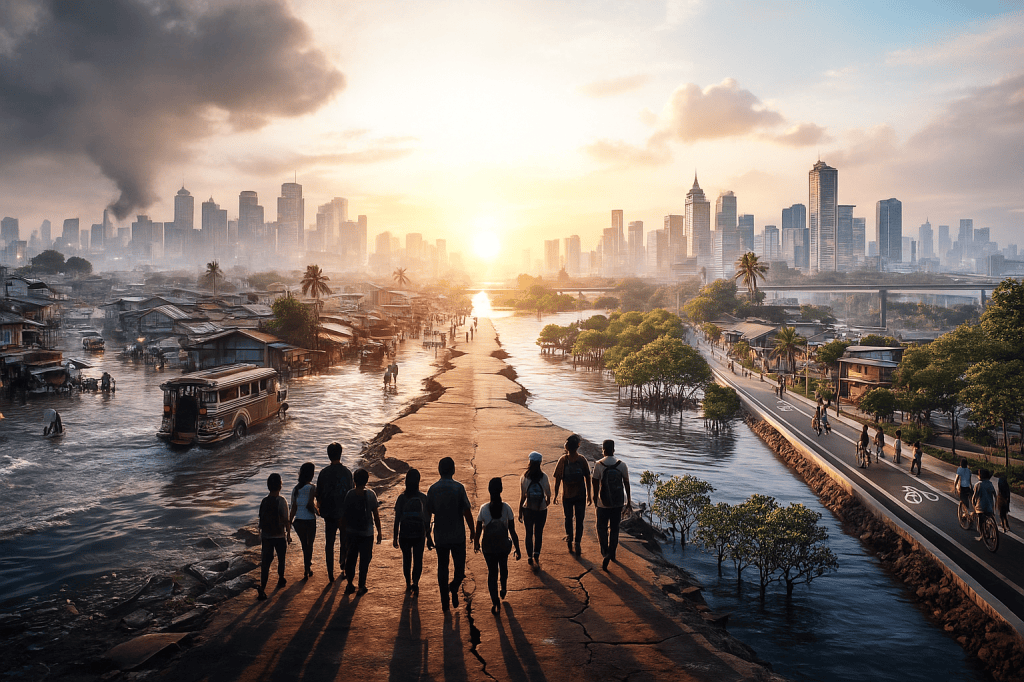
The choice is stark: continue shackled to nostalgia for a broken past, or free ourselves to build a just and transformative future that redefines how we live, work, learn, and govern.
The imagination premium is within reach — if we demand it, defend it, and act on it together.

